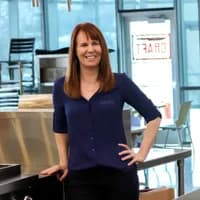
Episode 182 · May 5, 2025 · 14:08
Severine Riviere-Gerstner
Chief People Officer, Sportradar
Beyond the Org Chart: Empowering People Redefines Modern HR Leadership
Episode 182 · May 5, 2025 · 14:08
Beyond the Org Chart: Empowering People Redefines Modern HR Leadership
Key moments
In Severine's words
“You do not lead the same way in Germany or in Nigeria or Hong Kong or New York, right? So you need to adapt to your environment in the workforce, and more importantly, adopt different tools to lead.”
“You don't need to be at the top to create your success and overcome actually the challenges.”
“One of the key to success in everything that one can do, and it's dear to my heart, is make things as simple as possible.”
Transcript
Read the transcript2,133 words
HostWelcome to the Built by People Podcast, where we share the stories and insights of the world's top HR leaders. Join us as we dive deep into the minds of HR executives, uncovering their strategies, challenges, and triumphs in shaping today's workforce. I'm excited to welcome Severin to the Built by People Podcast. Severin, thank you so much for joining us. And as a starting question, I always love to ask if you could share a little bit more about your career journey.
GuestThank you for having me, Dave, and pleasure to be there. I think career journey, if I have to put it lightly, it has been only joy, a lot of challenges, but joy in the end. I had many experiences, but if there's a common thread in the last 22 years, it's really moving and working abroad. So really, the career journey I had has been in different places, different companies, different roles, whether local, regional, global, but moving abroad has been, for me, always the the driving force, and it has shaped me as an HR professional, and it has shown me that one career is self-driven and then the doors open. But more importantly, whether you're an HR professional or not, that leadership has different faces and expressions. You do not lead the same way in Germany or in Nigeria or Hong Kong or New York, right? So you need to adapt to your environment in the workforce, and more importantly, adopt different tools to lead. But yes, I would say the career journey has been only about learning from everywhere I went, and I'm still learning.
HostDeborah, can you share a specific case study that illustrates the impact of DEIB initiatives at Sportradar and how it has transformed the workplace culture?
GuestSure, happy to. The Sportradar DEIB plan, and we do have actually a plan and a strategy, has started, I would say, last year formally, definitely informally a few years before that. We've been working on different initiatives, adapting and refining them as we go along, as it's actually a never-ending field. But basically the goal is really to create a fair playing field for every individual to thrive, to contribute with their unique perspectives, and to make sure that we drive a sustainable future. More concretely, what we have been doing is making sure that we create the environment for an inclusive workplace, and this is still work in progress. And it has actually taken various shapes and forms as we are speaking, making sure that we first of all, and for example, strengthen our hiring practices around diversity, equity, inclusion, belonging. And we have started tracking our gender pay gaps and our, of course, progression on career. We start with gender, but more to come, of course, on different aspects of diversity. We are really excited about the topic, knowing that there is a lot to do. We also fostering our employee resources groups, which are employee-led, but again, with the vision that we want to make sure that We bring diversity in the organization everywhere and in everything that we do because it's a competitive advantage and we do believe in that. One thing I would like to highlight, which is actually the makeup of Sportradar. Sportradar is actually present in more than 25 locations globally and we have close to 80 nationalities. So you can imagine that on a daily basis, our different perspectives, background comes into play in how we work, how we interact with our clients and our partners. I would say a series of different actions. We tend to be more hands-on and on the spot without losing, of course, sight of that bigger agenda.
HostCan you tell us about a challenging obstacle you faced while implementing a significant HR program and the strategies you used to overcome it to ensure success?
GuestThere are many, if you ask me. There've been quite a few in the last 20 years plus, but I would say one, maybe one defining one. You, we always have one or many, but I will give you for today one defining one. It was years ago. I took over a role as strategic projects lead and learning for an emerging markets region. It was a new role. That region in that company was about 16,000 employees. And the mandate was, we need to definitely upgrade our capabilities there in that region. Here you go. I had absolutely no direct team. I had no budget. I was just brand new in this role, not in the company, but in this role. And I had to create the platform. So basically starting from scratch, you come here and say, how can I build that up? And by the way, It was a middle management position, so I want to highlight that because it doesn't really matter. You don't need to be at the top to create your success and overcome actually the challenges. And what I did, it's really playing by the book in action, I would say. It's really, first of all, getting the facts right, analyze the situation, getting the various insights, the diverse perspectives on the situation, on the needs. So really sounding the different point of views around me and put that then in a master plan, right? Craft, tangible, practical, and very simple. One of the key to success in everything that one can do, and it's dear to my heart, is make things as simple as possible. So build that in concrete action plan roadmap with the benefits that it can bring, right? And pilot at minimal cost because I had known how I did that basically was really to make sure that I would bring in with me some champions, people who've been also having local practices in various countries in that region, and making sure that we would build together some pilots, some local schools or training schools, put in place an internal curriculum for those capabilities that we had assessed or I have assessed with them, making sure that we started piloting and producing tangible results. And measure that. Feedback loop was something that I always did since day one when I started at Agenda, making sure that along the way I would get timely feedback, timely insights to adjust everything that was launched. And what it taught me is if you put your energy, your focus, you bring people around the table with you and you try and adjust along the way, I would say there's very little chance that you don't succeed. And the outcome of that, what I remember dearly is 2 years down the road after I started in this role, but really literally 2 years down the road, all of a sudden I get a budget of a few hundred thousands. We had 4 regional training centers in this region. We had a yearly curriculum that was discussed with the regional president and the leadership team. And we had more and more people behind that. Personally, as a professional, received an award for rolling in the fastest way the first-time manager program and trained 900, not me, but my colleagues, but being able to roll this out and 900 people went through that training in 2 years. With just me starting and of course colleagues who wanted and have accepted to join me along the way, That was actually a success that I was very proud of, still proud of that, because it just showed me that anything is doable. It's not a matter of position, it's not a matter of teams, it's really how you get people with you and how you execute.
HostSeverin, could you provide an example of a time when Sportradar's mission and values influenced a major decision or project and how that alignment with core values drove success?
GuestOh, again, plenty. But as we are talking about the HR profession and something that will or has and will always come as an HR professional, I would say most of the time is really when it comes to looking at organization, right? So organizational changes happen in every company. This is something that we had to do along the way to ensure the company's sustainability for the future. And at Sportradar, like many other companies, we had to go through that. And as much as it is a difficult exercise, and I want to emphasize that it doesn't matter if you do that for the first time or for the 10th time, the values and how we treat our people, how we operate, how we make decisions, this is when they come into play. To really make sure that from the first day of such project, for example, to the very last day, we treat our people with respect. We try to bring transparency and alignment as much as we can along the way. And nothing is perfect, but those values come always into play, often in times of crisis or difficult moment than moments of success. But those values have been essential. Whilst, for example, driving some organizational changes, we've recognized, of course, the importance of those values and making sure that we put our employee first. And when it comes to whatever we do, and I would say that was a particular example, but if I have to highlight, we are about integrity. Integrity governs what we do, first of all, with our employees, but also with our clients, partners, colleagues. This is also why Our partners have chosen us because we operate only in regulated markets and we are the partner of choice when it comes to integrity. And whether it's winning the next deal, which we win every day or we definitely strive to, we get together and work together as one team. And this is something that either we do it well or we do not do it well. This is, for example, those values that help us every day making sure that we make the right decisions and we act in the right fashion.
HostCatherine, what parting advice would you like to share with our community?
GuestI tend to think that once you put your foot as an HR leader, you need to be mindful that you have a voice, but that voice can only actually amplify if you first listen. And listen, listening is so critical in not only in our profession, but as a leader that we tend to forget, right? It is important to master your craft and have a point of view, by the way. It's really important to come with a point of view, but one needs to start by listening and making sure that as you grow in your career, You self-manage and you self-correct, being humble enough to recognize then you have to change the way you operate, you analyze, you get the feedback, and you correct. And you, as I like to highlight, build your own board of directors. And that board of directors have different hats on. It can be your mentors, can be your colleagues, can be your boss. It could be your team that is very different than you, wearing bikes. Anyone to have a team that is very different than self. And making sure that board of directors within your current job or roles you have been in are there to support you, to guide you, to challenge your perspective all the time. You might have guessed a little bit, or I tend to think that nothing is set in stone. Keeping on learning is important. Complement this with One thing as a piece of advice that I don't know the answer of, but this is something that I'm seeing actually evolving, is watching technology. And technology, because we are a technology company first, and technology is again at the core of what we do, but at the same time, technology evolves in an exponential fashion., right? As much as we know a few things today, there are many things we don't know today and tomorrow. And we need at the same time to adapt, to catch up, to anticipate what we can and potentially also what we don't know. The watch out that I would give, and the last piece maybe from a context perspective and timing perspective, is really making sure that we adapt to the technology, right? And making sure that we take technology into account in what we do. That requires us to unlearn a lot and relearn a lot. So that will be my recommendation today.
HostSeverin, thank you so much for joining us on the Built by People podcast. It was a pleasure to have you involved.
GuestMy pleasure. Thank you for having me, Dave.
More conversations like this