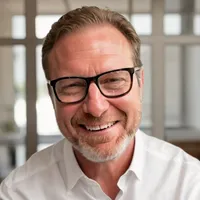
Michael Baer
Chief Marketing Officer (Fractional CMO)
Tech CxO
What got them to where they are today will not be the same model
Thesis
“Sustainable business growth, especially for early-stage companies, hinges on first establishing a clear strategic foundation rather than seeking quick hacks. He also advocates for exploring entrepreneurial paths at any career stage, given the evolving landscape of traditional employment.”
Show notes
Summary
In this episode, Michael Baer shares insights on building strong foundations for growth, the importance of strategic clarity, and how to transition from full-time roles to impactful consultancy. Discover practical advice for early-stage companies and aspiring leaders looking to scale and professionalize their businesses.
Key Topics
- Building strategic foundations for growth
- The role of clarity in scaling a business
- Transitioning from full-time roles to consultancy
- Practical advice for early-stage companies
- Leadership insights for aspiring consultants
What you'll take away
- 01Building a strong strategic foundation (positioning, personas, value proposition, messaging) is crucial for accelerating growth, not slowing it down, especially for fast-growing companies.
- 02Companies must evolve their models; what led to current success won't necessarily lead to 2x or 10x growth, requiring professionalization of go-to-market and storytelling.
- 03Consultants can provide rapid, impactful insights by having 'hard conversations' and offering direct, unbiased feedback that internal teams might avoid.
- 04Leaders should prioritize regular one-on-one meetings with every team member, even in large, dispersed teams, to foster connection, gather direct insights, and empower employees.
- 05Consider entrepreneurship or consulting at any career stage, as traditional W2 employment may no longer offer the same stability or rewards it once did, and tools for monetization are more accessible.


What most organizations get wrong
- The idea that building a strategic foundation (positioning, messaging) for fast-growth companies actually 'helps speed you up' rather than being a time-consuming detour.
- The assertion that traditional W2 employment is no longer as stable or rewarding as it once was, encouraging individuals to consider entrepreneurial paths at any point in their career.
In Michael's words
“building a foundation meaning really clarifying your strategic underpinnings, your positioning, your Personas, your value proposition, the messaging story that you tell isn't a waste of time. In fact, quite frankly, it helps speed you up.”
Highlights the core argument that strategic foundational work accelerates growth rather than hindering it.
“what got them to where they are today will not be the same model, the same approach that gets them to 2x or 5x or 10x.”
Emphasizes the need for companies to evolve their strategies and operations to achieve significant future growth.
“As a consultant, I mean, I'm being paid to really have the hard conversations and if, if necessary, tell a client that their baby's ugly. But here's what we're going to do to make that baby, you know, good looking.”
Illustrates the unique value and directness an external consultant can bring by providing honest, transformative feedback.
“I made a point to meet every single one of them every quarter, spend one on one time with each of them... And it made a difference both to me because I was hearing from people... but it was really meaningful to them too.”
Demonstrates an effective leadership practice for fostering connection and gathering insights within a large, dispersed team.
“I don't think working for a company is very, you know, as is anywhere near as stable for people as it. As it. As it was. And I think being an employee is less, I don't know, rewarded than it used to be.”
Challenges the traditional perception of stability and reward in corporate employment, advocating for alternative career paths.
The problems this episode addresses
- Companies seeking quick growth hacks without establishing a solid strategic foundation (positioning, messaging).
- Early-stage companies struggling to scale beyond initial success due to a lack of professionalized go-to-market and storytelling.
- Leaders needing to effectively connect with and empower large, dispersed teams.
- Individuals feeling stuck in traditional W2 roles despite diminishing perceived stability and rewards in corporate employment.
In this episode
Intro
Welcoming Michael Baer
As you think about growth, what are your top priorities
You work with a lot of smaller to small to mid market companies
If you could leave one piece of advice, maybe for our community
Topics covered
Organizations and entities mentioned
Full transcript
Expand transcript (2054 words)
Welcome to the Built by People podcast where we share the stories and insights of the world's top executive leaders. Join us as we dive deep into the minds of executives, uncovering their strategies, challenges and triumphs in shaping today's workforce. Now let's jump in and get started with our next guest.
Thanks for joining the Built by People podcast. I'm joined today by Michael Baer. Michael, thanks for joining us today.
Thank you, Dallin. Good to be here. Absolutely.
Hey, as always, start off by talking a little bit about your career journey. The unexpected turns, what ultimately led you to where you are today.
I think it's been a focus on driving growth, in helping companies find a way to tell their story and drive growth. And that's been a common denominator in my career from days as an agency through being CMO of B2B companies and now as a consultant. It's something that, that drives me. I can't explain why, but ideas and kind of belief and brand purpose has been a throughput, I think through all my work.
I love that. As you think about growth and the things that you have on your plate right now, what are your top priorities?
I do a lot of work with early stage and growth companies. And so one of my priorities is to help companies who want to get somewhere fast recognize that they need to build a foundation first. And that building a foundation meaning really clarifying your strategic underpinnings, your positioning, your Personas, your value proposition, the messaging story that you tell isn't a waste of time. In fact, quite frankly, it helps speed you up. And so many companies just want that fast. You know, shortcut to how do I make something happen quickly, how do I press a button, how do I get some sort of hack to get the solution? Is there an agent for that, so to speak? And so one of my priorities is, is identifying that the, that the foundations that once they're in place, you can move faster and that it helps everything. I mean, truthfully, it's not a marketing thing at all. It really helps formalize product and the product vision and roadmap. It helps formalize the way you hire and how you incentivize people again based on the types of beliefs that teed up your business in the first place. It helps, you know, hiring, it helps everything to have that kind of clarity. And I think a lot of early stage founders, you know, they have so, you know, they've done so much, they've created this, you know, in many cases of an innovative breakthrough product, they've gotten, you know, from zero to somewhere, unbelievable amount of effort and entrepreneurship and insight. But there are aspects that they may not find as urgent that I think end up being really the difference between future success and maybe stalling out or at least idling in place for a while.
Yeah, that makes a lot of sense. You know, as you think of your work with, you know, multiple clients and things like that, what's one initiative you've rolled out recently that you're really proud of?
You know, like I said, I work with a lot of smaller to small to mid market companies, often very small as well as I do a lot of work. I've done a lot of strategic work not as a fractional cmo. So I'm a fractional cmo. I know we kind of jumped past that and I don't know if we'll come back to it. But I work for a fractional C suite consulting company. So I have 125 partners across the C suite and I work with, sometimes we work together with fractional CFOs, CTOs and I'm a CMO. But I also do work as I would call it probably just strategic marketing consulting with specifically one larger company, GE Healthcare and some others sort of in that upper mid market and even enterprise level. But it's often the work that I do with these small companies that is the most rewarding because it can be so foundational or so, you know, kind of fundamental to them getting to the next step. I always say companies recognize they need help when they've gotten somewhere. But they also recognize that what got them to where they are today will not be the same model, the same approach that gets them to 2x or 5x or 10x. And what they need to do is professionalize aspects of their business, their go to market, their storytelling, their website. They need to kind of step up, they need to appear bigger than they are, they need to begin to draw bigger fish. And to do that they don't necessarily need to hide, hire somebody full time. They need somebody to help get them there and even maybe bring on those personnel who can help then do that. But what's really rewarding is when you Help companies. And one of the things, during my transition from full time work, I have a long career of being a, you know, a W2, a CMO or a full time employee. I transitioned into a consulting work and what I found was it was incredibly emotionally rewarding to me. This kind of pivot. I mean the pivot being, yes, sometimes I'm very much part of a team, but this idea of onboarding and slowly, you know, learning a culture and reading a room before you speak or you know, not rocking a boat for the first X number of, you know, months or so, it's off the table. As a consultant, I mean, I'm being paid to really have the hard conversations and if, if necessary, tell a client that their baby's ugly. But here's what we're going to do to make that baby, you know, good looking. And because of that, you can get somewhere so quickly. You can make, you can make such an impact quickly and that's really the emotional reward. So just like, here's an example, I'm working with a small company, recognized they needed help. They said, we need to build a website and a better website. And they began to do work and they did some good work. But they finally realized they needed to bring somebody in. And in just one month's time I did an assessment. I interviewed some of their customers, I interviewed these guys. I dug into it and I came back with, you know, good start, but and I provided, here's what I think, the opportunity to frame your story more powerfully. Here's, here's a way to update your go to market. And it just like it kind of blew them away. And I could see, wow, we're gonna, you know, they're gonna turbocharge their next steps in growth because of it versus again, you know, coming on board to a company, you know, really digging into what people have done. You never want to tell somebody a company that you work for that the work they've done in the past didn't quite measure up. But here's an example of really quickly getting in one month and now we're now building. So they've hired me to stay on and now I'm literally helping them build the future of this company. And so it's really rewarding and exciting and satisfying.
I love that. That's great. And I love that there's such fulfillment on your side on a personal level, but also for the clients that you're serving. Right. If you could leave one piece of advice, maybe for our community, this could be for a senior leader that's wanting to get into consultancy. This is for an aspiring leader, right? Someone that's, that's still stuck in the W2 world, right?
What would it be?
And you know, is there, is there anything that you found over the course of your career where you're like, man, I'd go back and do this or this is be kind of my silver bullet.
I hadn't given this a ton of thought, but a couple things immediately come to mind. Totally different from each other. But one is an idea of really, if you are working in a company, I think there's a lot to be gained by spending time with your employees to senior leaders. My last full time role, I led a team of a dispersed team of 125 people across all of marketing. So it included various departments that hadn't been joined together. People who hadn't really seen any, you know, each other, didn't view each other as colleagues as well as didn't really feel like they had a leader that enabled them or empowered them. And I made a point to meet every single one of them every quarter, spend one on one time with each of them, which was hard to do, as you can imagine, with a full, full calendar. And sometimes I had to make them 15 minutes or whatever. But I made a point of it. And it made a difference both to me because I was hearing from people. I got to know people personally, could hear things differently than through the grapevine. I'm hearing things directly. Even if people don't want to tell you their issues, maybe directly, but it was really meaningful to them too. I know it was. I mean, I could feel it in the meetings, but I got a sense just walking the halls that, you know, people felt connected to leadership in a way that they hadn't before. So that's, you know, that's, that's one thing, but then the other thing I'd say is almost contrary. This pivot that I've made is a lot to do and we talked about it in the lead up to this Dallin. This kind of end of career, towards the end of career pivot that makes sense for people like me who've had a, a long career can leverage a horizontality of diversity of experience and want to keep playing, but don't want to like run a group and have, you know, sort of that kind of responsibility. So that makes sense. But I also encourage people at any point in their career to explore building this kind of, this kind of engagement, this kind of model, you know, for a variety of reasons being, you know, when I came up through the business world, it certainly was understood more than perceptually. I think it was fairly true that working for a company did give you a certain amount of stability. Stability is important for people as they grow and take on debt and take on children and those kinds of things. I don't think it's as true anymore. I don't think working for a company is very, you know, as is anywhere near as stable for people as it. As it. As it was. And I think being an employee is less, I don't know, rewarded than it used to be. And so finding a way to create your own path is pretty empowering. It's not for everyone and it's also challenging again, as you have commitments and have needs. But it can be done. It's never been easier to do. By the same token, with the amount of people doing it is a little bit more competition, I suppose. But the tools that are at your behest, the availability of ways to monetize your time has never been probably easier. And it's pretty empowering. So that's something I would say those of you who you know may not be towards the tail end of your career and wonder about it, I'd say don't think you can't do it because there's a lot of opportunity out there.
Thank you, Michael. Really appreciate that inspiring perspective. Thank you for who you are and what you're doing. And thanks for joining the Built by People podcast today.
Thanks for having me, Dallin. Love to come back sometime and thank you. Anybody who's listening. I can be reached at Michael Baerechcxo I work for the company Tech CxO, so anybody wants to send an email or reach out, please do again. Michael baerechcxo.com I enjoyed it, Dallin.