SHRM26 Debrief · Talent Management & Acquisition · #2669
The Talent Playbook; Data-Driven and Human-Centered
with Reagan Kelley
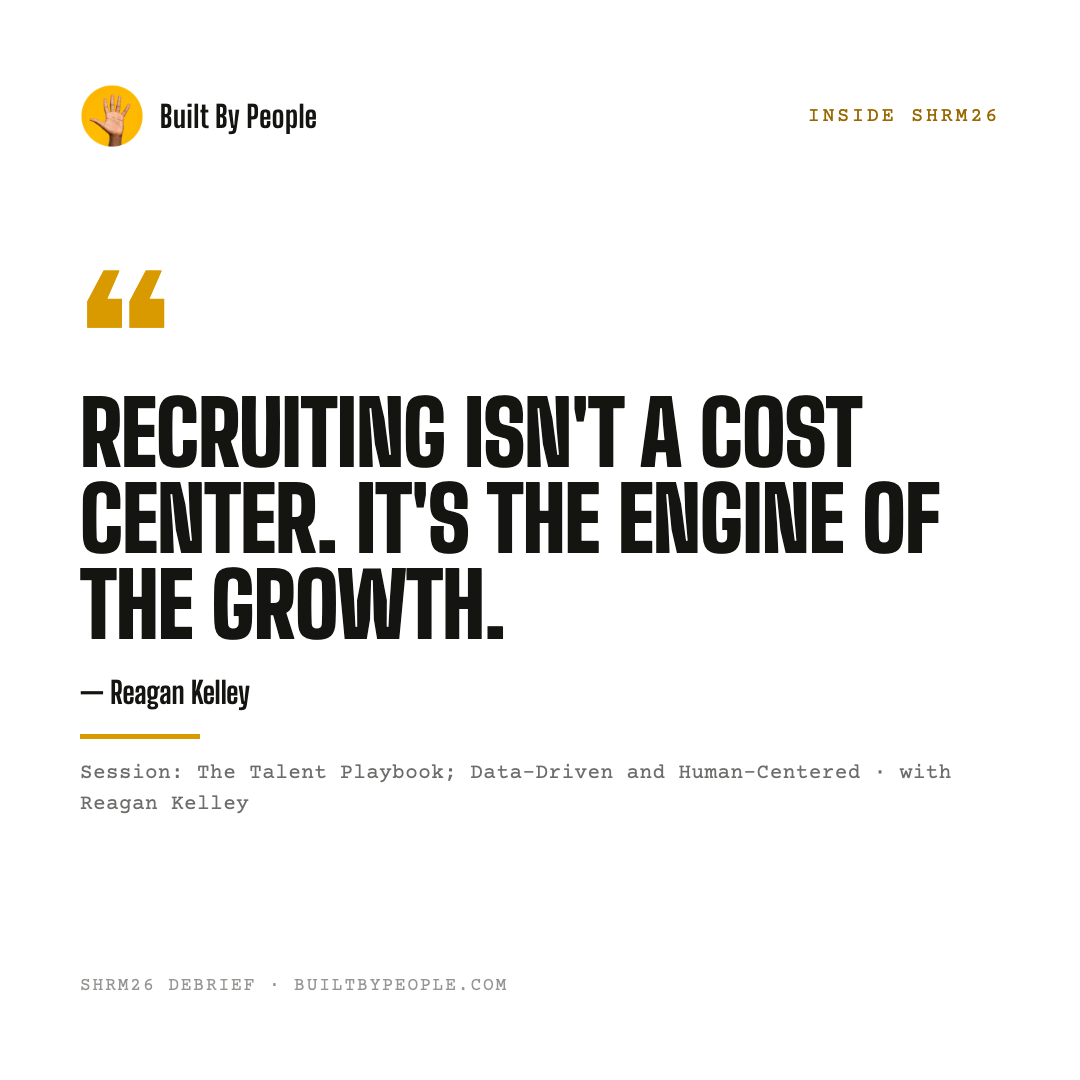
"Recruiting isn't a cost center. It's the engine of the growth."
What it was about
Talent acquisition should stop presenting itself as a tactical cost center and instead reframe every open role as a live financial event. Using business-outcome metrics, predictive workforce planning, and benefits fluency, TA can earn a strategic seat at the C-suite table.
By the numbers
50% to 200% of annual salary
SHRM estimate of full cost to replace a role
18% of salary
productivity lost to a disengaged employee
~70%
share of employed people the speaker cites as passive talent open to a call about a new role
Key notes
- Reframe every open requisition as a live financial event tied to a dollar cost, not just a task to close, so leadership sees TA's business impact.
- Track a Quality of Hire score (average of 90-day manager performance rating, ramp-up speed, one-question manager satisfaction, and 12-month retention) instead of leaning only on time-to-fill.
- Benchmark cost per hire, time to fill, offer acceptance rate, and 90-day retention against industry average and top-quartile figures from SHRM and LinkedIn to set concrete improvement targets.
The contrarian takeVacant 'overhead' roles that a CEO views as cost savings actually generate hidden costs through burnout, lost institutional knowledge, and eventual replacement expenses that can exceed what was 'saved' by leaving the position open.
Take this back Monday
Do this for your team
Build a one-page benefits cheat sheet with dollar values and have recruiters mention it in the very first candidate call.
Say this in your next leadership meeting
Every open role is a live financial event, not a task to close: recruiting is the engine of growth, not a cost center.
Watch out for
- Measuring and celebrating time-to-fill alone without attaching a dollar figure, which fails to register with CEOs.
- Only bringing up benefits at the offer stage, after a candidate has already made roughly 80% of their decision.
- Letting hiring managers stack unrealistic interview panels (e.g., requiring an entire team on every interview), which drags out time-in-stage and loses candidates.
Fun fact · Reagan Kelley
Before leading talent acquisition at Marsh McLennan Agency, Reagan Kelley trained as a licensed mental health therapist with a master's in social work.
If this landed, see these
↳ Go deeperNegotiating Job Offers: Master These New Strategies to Win Over In-Demand CandidatesExtends "benefits fluency" into offer negotiation: dig into values and dealbreakers, don't just pitch.⇄ The counterpointHandling Departures: The Task that Most Impacts Your CultureArgues retention hinges on how you handle exits, not how you price open reqs.✦ The unexpected oneThe Benefit That Quietly Shapes How Work Gets DoneThe exact underused benefit recruiters could flex on that first candidate call.