The SHRM Workplace Culture Navigator: Exploring 8 Organizational Culture Types

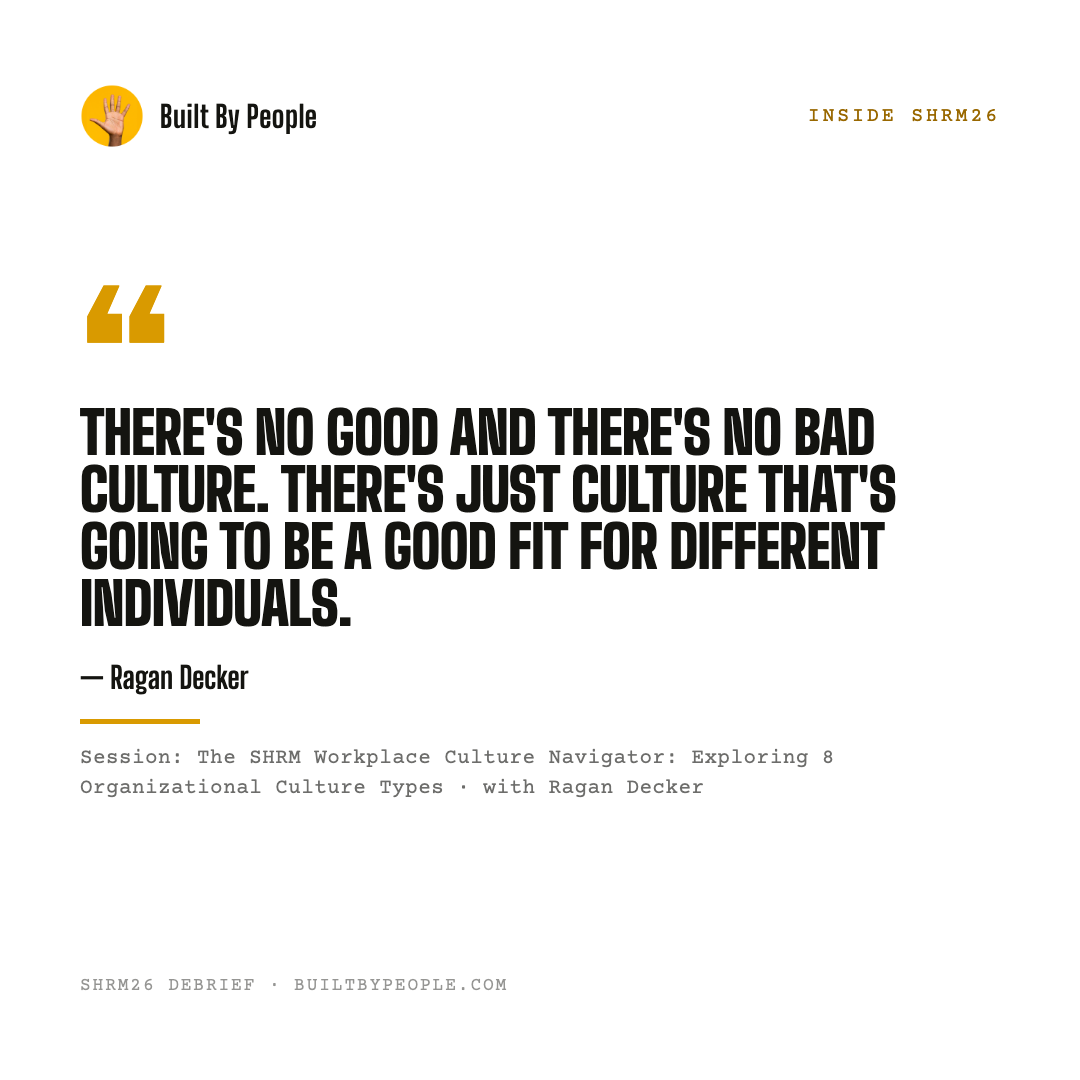
"There's no good and there's no bad culture. There's just culture that's going to be a good fit for different individuals."
What it was about
There is no universally good or bad organizational culture, only the culture that best fits an organization's strategy and desired outcomes. SHRM's Workplace Culture Navigator uses three dimensions, strategic orientation, work processes/systems, and interactions/relationships, to classify organizations into eight measurable culture types, each with distinct strengths, challenges, and outcome profiles.
By the numbers
Key notes
- Diagnose your organization's position on three dimensions (short-term stability vs. long-term growth, hierarchical/centralized vs. flat/decentralized, closed/individualistic vs. open/collectivistic) to identify which of the eight culture types you actually have.
- Treat culture as a measurable, investable strategic asset that directly links to business outcomes rather than a vague, unmeasurable internal value.
- Use your organization's specific culture type as a market-facing competitive differentiator (e.g., growth collaborators differentiate through innovation and collaboration; strategic architects differentiate through disciplined, structured decision-making).
Take this back Monday
Map your team on the 3 culture dimensions, then rewrite one job posting to honestly reflect that culture instead of overselling it.
There's no good or bad culture, only the culture that fits our strategy — and SHRM's data ties each of the 8 types to measurable outcomes.
Watch out for
- Assuming there's a single 'best' or 'right' culture rather than recognizing culture is context- and strategy-dependent (e.g., a nuclear power plant needs hierarchy for safety, a tech startup needs flat/decentralized for speed).
- Overselling the organization's culture during hiring instead of being honest about what it's really like, which leads to mismatched hires and surprise/disengagement post-onboarding.
- Trying to force one uniform culture across highly divergent sub-teams/microcosms without first asking whether those teams have genuinely different outcome objectives that justify different cultures.