The HR Evolution: Leading with Civility in an Era of Complexity and Change

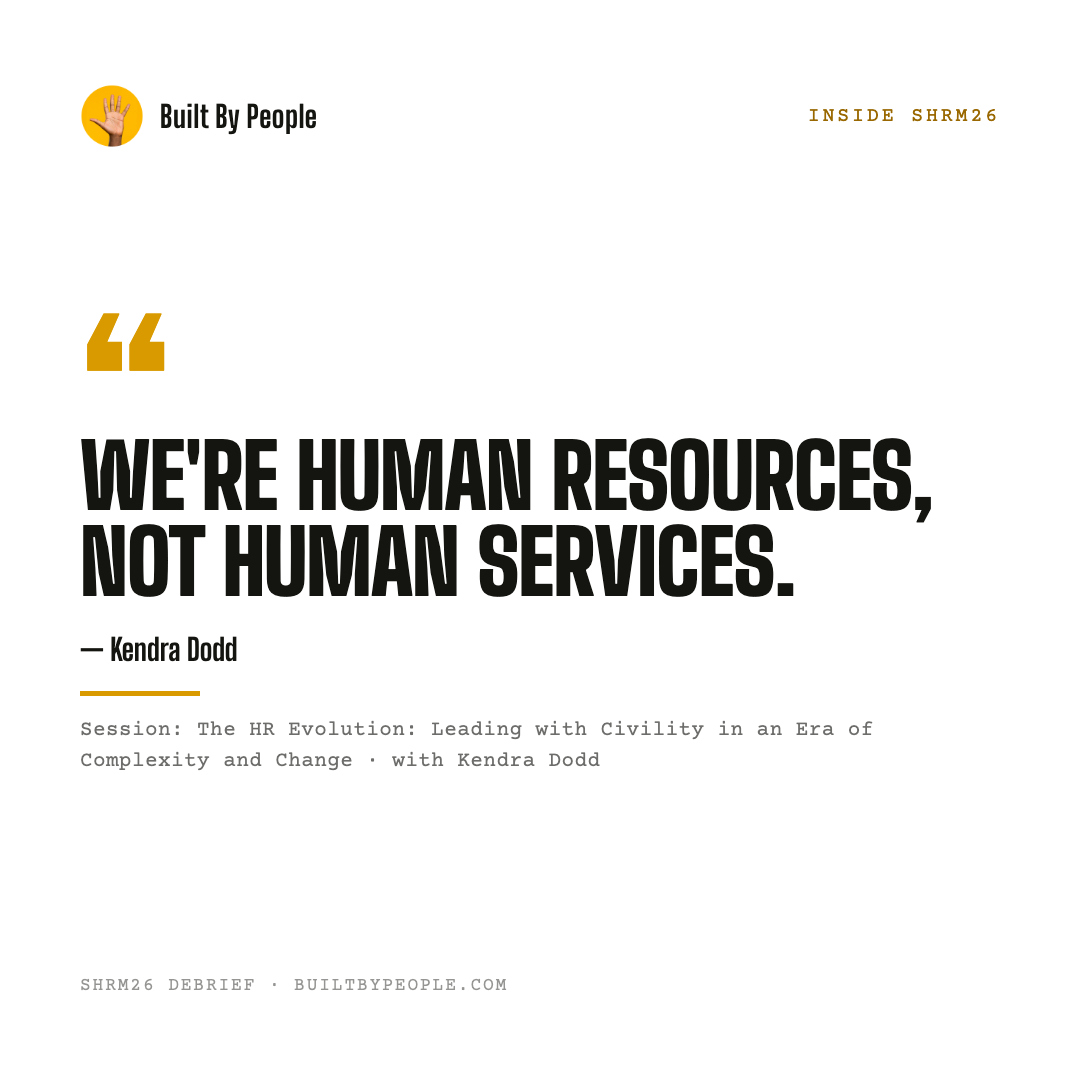
"We're human resources, not human services."
What it was about
Every era of HR (personnel, employee relations, HR, strategic partner, culture/engagement, transformation) solved one structural problem but never removed the underlying work — it just accumulated, and each solution revealed a new people problem; HR's real job is to steward the complexity of people, not the systems, policies, or technology themselves.
By the numbers
Key notes
- When implementing any policy or change, explicitly assess what people are losing and what they are gaining, not just whether the change makes logical sense.
- Use the 'gap' self-assessment before rolling out a change: identify whether resistance stems from priority, focus, communication style, communication mode, or pressure, and address that gap specifically.
- Address incivility early, in the 'distracting' stage (eye-rolling, gossip, disengagement), before it escalates to disruptive behavior or bullying — six months of unaddressed disruption crosses into bullying territory.
Take this back Monday
Use the 'gap' check on your next policy rollout: ask if resistance is priority, focus, style, mode, or pressure — then address that specifically.
Every HR era solved one problem and left the work behind — our job is stewarding people's complexity, not just adding more systems.
Watch out for
- Treating a policy problem (e.g., nepotism, attendance tracking) as purely procedural instead of recognizing that resistance is really about loss, trust, or fairness.
- Assuming 'positive intent' without actually engaging or listening, which the speaker argues is not the same as being charitable.
- Letting managers misuse policies (e.g., attendance policy) as a weapon to justify firing people rather than to coach behavior.
She invented her own leadership tools — the Diamond Leader framework and the SEE(D) communication method — and wrote a book, Perspectives.