The Art and Science of Asking Transformative Questions

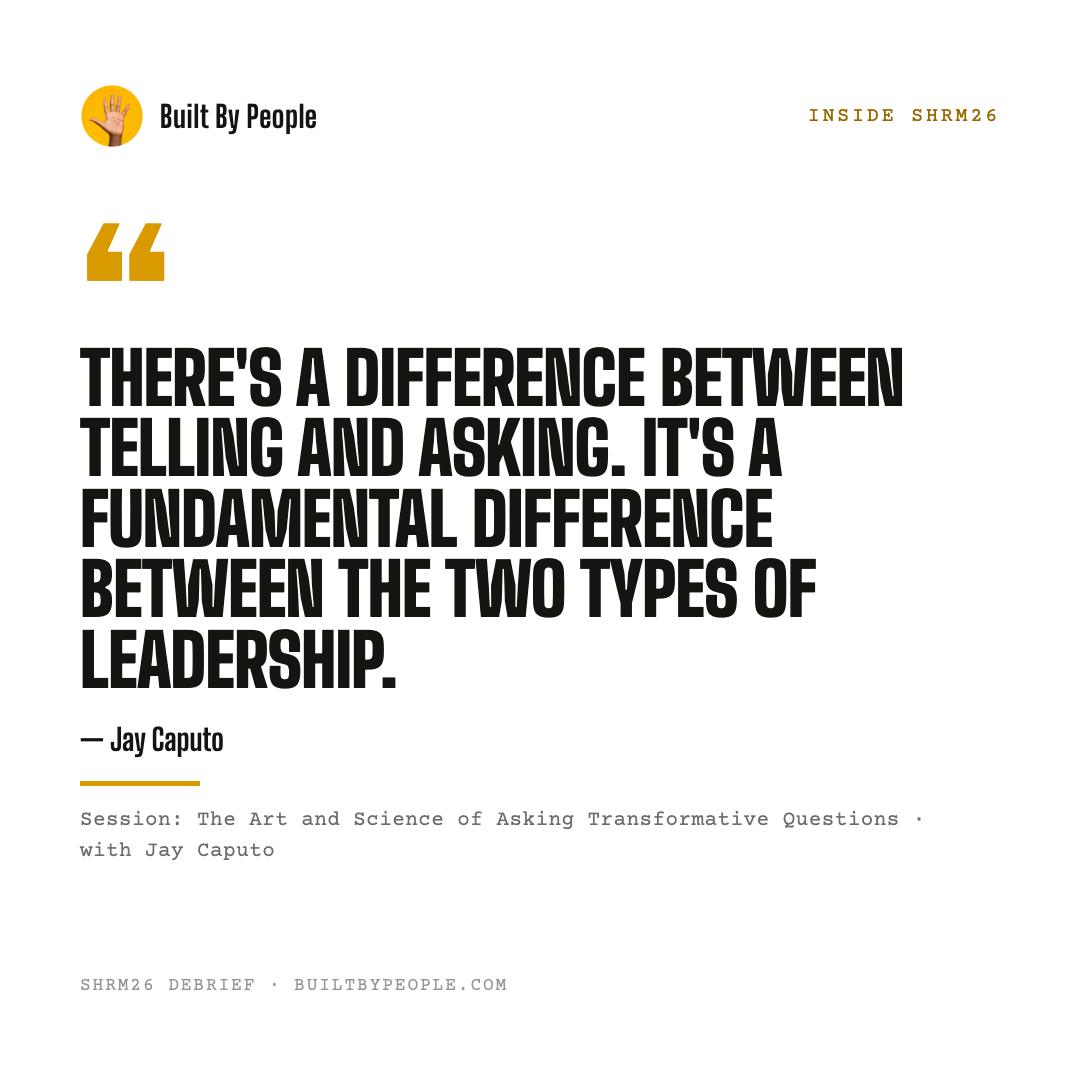
"There's a difference between telling and asking. It's a fundamental difference between the two types of leadership."
What it was about
Effective leadership hinges on the interplay between listening and asking questions. By understanding the five qualities that shape any question (open/closed, time, emotional tone, scope, and being/doing/having), leaders can deliberately craft more transformative questions instead of defaulting to transactional ones.
By the numbers
Key notes
- Practice giving back what you hear ("What I'm hearing you say is...") instead of asking "Do you understand?" to force genuine listening and check understanding.
- Evaluate every question against five qualities — open vs. closed, time orientation (past/present/future), emotional tone (negative/neutral/positive), scope (general/specific), and being/doing/having. and deliberately aim for the combination of open, present-to-future, neutral-to-positive, and specific questions.
- Purposefully design 'being' questions (about values, feelings, mindset) rather than only 'doing' or 'having' questions (about actions and results), since being is harder to measure and gets taken for granted.
Take this back Monday
In your next 1:1, swap 'Do you understand?' for 'What I'm hearing you say is...' and ask one 'being' question about values or mindset.
Great coaching isn't advice in disguise — it's asking open, future-focused questions that show you trust people to find their own answers.
Watch out for
- Asking a string of closed, interrogation-style questions (e.g., repeatedly nailing down deadlines) instead of using closed questions intentionally to set up open ones.
- Defaulting to advice-giving ('telling') because it feels good and validating, rather than asking questions the other person can answer themselves.
- Over-relying on past-focused questions because the past is 'safer' (known) than the future, which limits transformative, forward-looking conversation.
Jay Caputo has logged over 10,000 hours of professional coaching and once served as a certified District Court Mediator in Washington, D.C.