SHRM26 Debrief · AI, Data & Tech · #3765
The AI Maturity Playbook: Build Trustworthy Tools for Recruiting, Rewarding, and Retaining Talent
with Katy Huston & Kristie Rowley
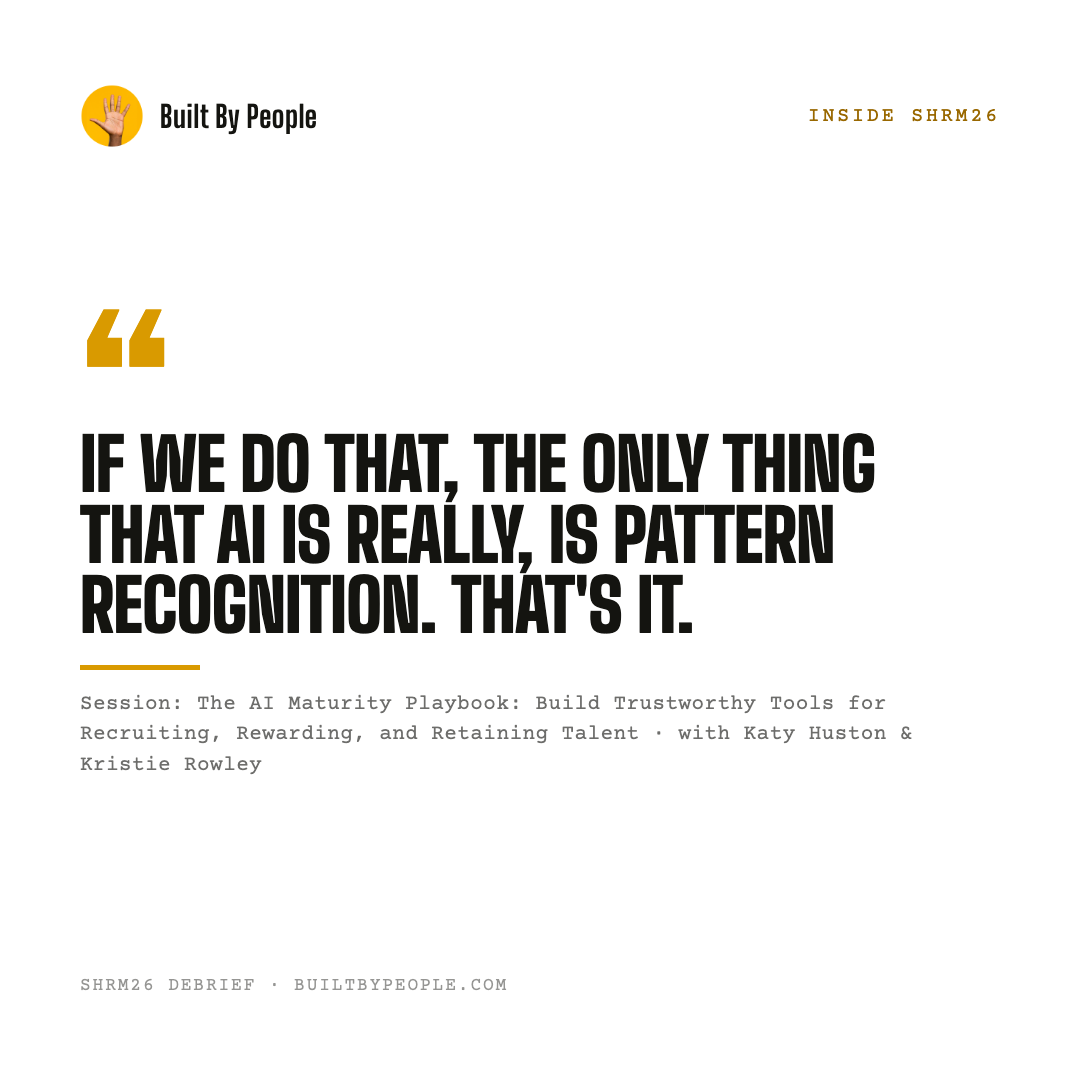
& Kristie Rowley"If we do that, the only thing that AI is really, is pattern recognition. That's it."
What it was about
AI is fundamentally just pattern recognition, and HR professionals are already skilled change-guides who should lead their organizations through an AI maturity journey (exploring, building, scaling, optimizing, pioneering) by building trust, providing rich context, and keeping humans in control of the final decisions.
By the numbers
72% accuracy
Turnover-prediction accuracy achieved after incorporating the weekly one-question sentiment signal into the AI model
33% (a third of the time)
Baseline turnover-prediction accuracy for the example company before using AI with better context
up to seven, eight, nine (patterns), game over after 10
Approximate number of patterns a human can track before attention drops off, contrasted with AI's pattern-recognition capacity
Key notes
- Assess where your organization and you personally sit on the five-stage AI maturity journey (exploring, building, scaling, optimizing, pioneering) and pick one practical next step to start on Monday.
- Be transparent with employees about AI uncertainty rather than pretending to have all the answers — honesty about not knowing builds more trust than false confidence.
- Feed AI tools rich context (who you are, your team, goals, style guides, non-negotiables, values) because AI's only real capability is pattern-matching against the information it's given.
The contrarian takeRather than pursuing one 'best' AI platform, the speakers argue HR professionals should deliberately use multiple AI tools (Claude, ChatGPT, Gemini) against each other on the same task and let them cross-check and improve one another's outputs, rather than standardizing on a single vendor.
Take this back Monday
Do this for your team
Have managers start asking each employee one weekly check-in question (thumbs up/sideways/down) to catch flight risk early.
Say this in your next leadership meeting
AI is just pattern recognition — it only gets smarter about retention if we feed it real context, like weekly employee check-ins.
Watch out for
- Treating AI as if it has ingenuity or genuine understanding rather than being purely a pattern-recognition tool trained on existing data.
- Putting real, sensitive, or HIPAA-protected employee data into free/unsecured AI tools without established governance.
- Turning over AI-generated output (e.g., a job description) as a finished product without human review and revision.
If this landed, see these
↳ Go deeperStrategic AI Adoption: Designing Smarter WorkflowsTurns 'pick one AI step for Monday' into a full process-by-process adoption roadmap.⇄ The counterpointReturn on Intelligence: Move AI ROI Beyond Cost to Competitive AdvantagePushes back: AI compounds like a new hire's onboarding, not just pattern matching.✦ The unexpected oneModernizing Compassion: How Strategic Bereavement Policy and Prepared Leaders Support Employees Through LossSame real lesson: the tool matters less than whether managers have the context to use it well.