Strategies for Navigating ADA Compliance in the Age of Artificial Intelligence

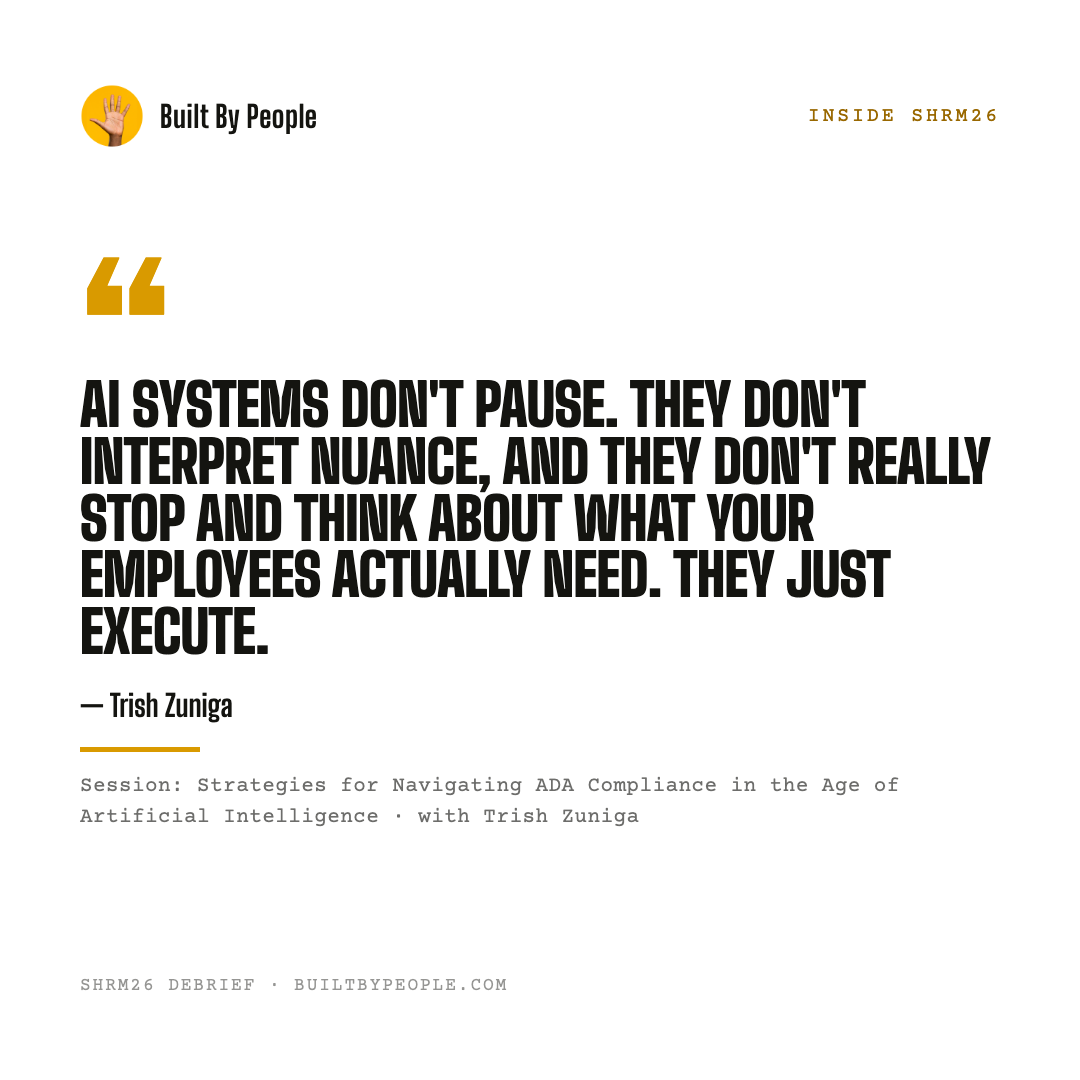
"AI systems don't pause. They don't interpret nuance, and they don't really stop and think about what your employees actually need. They just execute."
What it was about
AI tools embedded across the reasonable accommodation lifecycle can silently break the ADA's requirement for an interactive, individualized, human process, so employers must anchor AI governance in responsible-AI principles (mapped via frameworks like NIST) rather than chasing constantly-changing AI regulations.
By the numbers
Key notes
- Map every point where AI touches the accommodation lifecycle (intake, information gathering, interactive process, evaluating options, implementation, monitoring, documentation) and decide human-in-the-loop vs. human-on-the-loop for each step.
- Assign explicit accountability for AI/ADA compliance across HR, IT, legal, and vendors so no one can claim 'someone else owned it' if a dispute arises.
- Apply the NIST AI Risk Management Framework's Govern-Map-Measure-Manage cycle as a stable, law-agnostic foundation instead of reacting to each new AI regulation.
Take this back Monday
Map every AI tool touching accommodation requests (intake to documentation) and flag where a human, not the AI, must make the call.
AI can process accommodation requests, but it can't run the ADA's interactive process for us — that still has to be a human conversation.
Watch out for
- Treating AI governance as an abstract compliance exercise disconnected from real workflow breakpoints, like when a hiring manager blindly trusts an unexplainable AI score.
- Letting AI-enabled workflows execute automatically without pausing for the human judgment the ADA's interactive process legally requires.
- Chasing individual, rapidly-changing AI laws (EU AI Act, Colorado's law) jurisdiction by jurisdiction instead of building on stable responsible-AI principles.
She holds two law degrees — one from George Washington University and one from Ateneo de Manila University in the Philippines.