State of the Workforce 2026: What to Keep, What to Change, and What AI Is Actually Doing to Your Employees

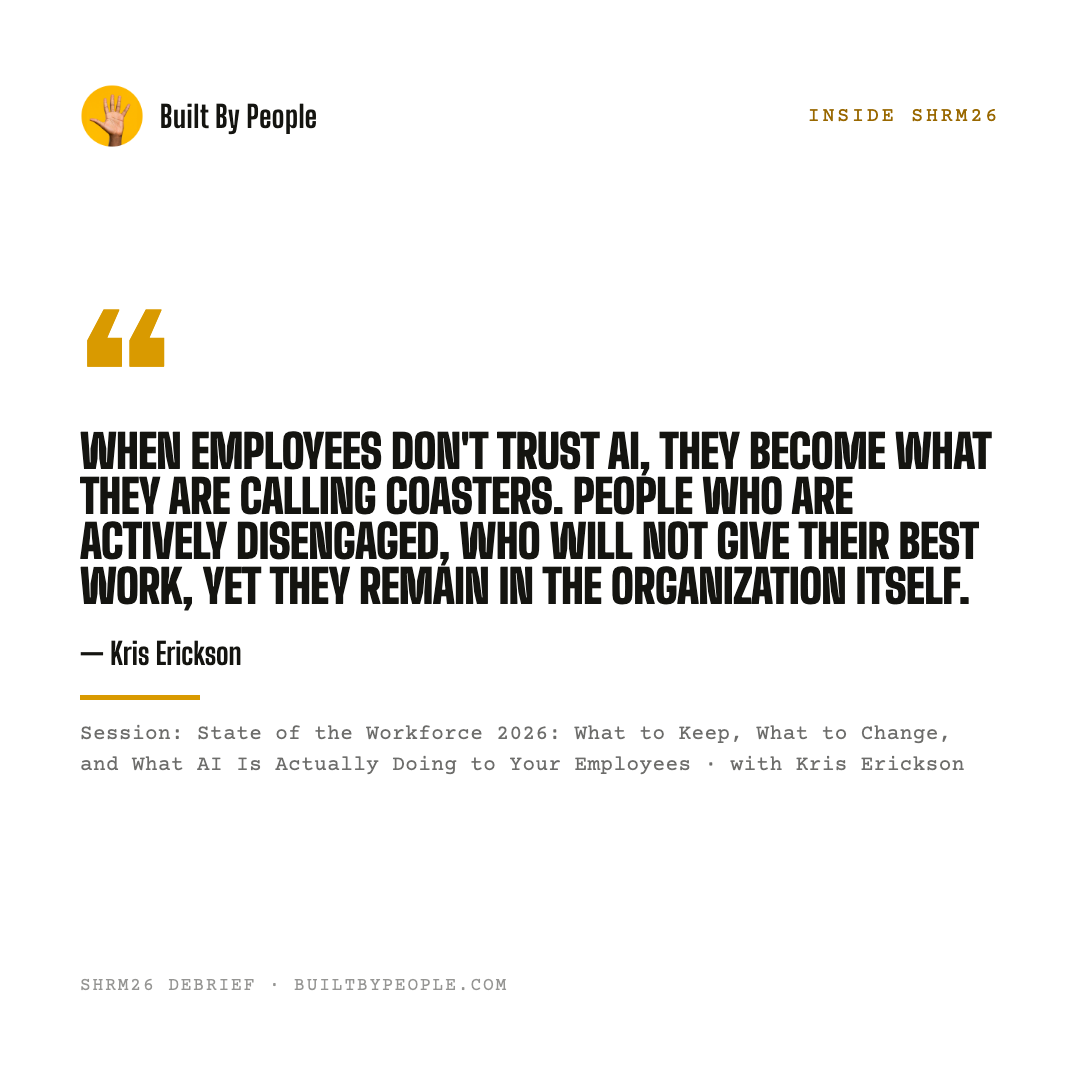
"When employees don't trust AI, they become what they are calling coasters. People who are actively disengaged, who will not give their best work, yet they remain in the organization itself."
What it was about
Drawing on a 10-million-respondent, three-year rolling workforce database, the speaker argues that surface-level conditions (work arrangements, generational makeup, AI adoption) are shifting fast, but the core human predictors of engagement and leadership effectiveness are stable. Organizations win by shoring up those fundamentals and treating AI adoption as a trust and change-management problem, not a technology rollout.
By the numbers
Key notes
- Track the 15 predictors of engagement across three tiers (foundational, bridge, heart) instead of relying on the old 'drivers of engagement' model, since foundational factors prevent disengagement but don't drive it.
- Treat leadership effectiveness (measured by 'I believe my manager is an outstanding leader') as a distinct, more stable metric from engagement. Build its four predictors, active communication, integrity and trust, growth orientation, and relational strength, into performance reviews and 360s.
- Segment engagement data by gender, organizational level, generation, and work arrangement, since aggregate numbers hide major divergences (e.g., male vs. female senior leaders, on-site vs. remote/hybrid).
Take this back Monday
Ask your team directly how they feel about AI at work (using something like a Readiness/Initiative/Success/Expectation pulse) instead of just tracking usage.
Good AI strategy is good people strategy — if employees don't trust AI, they quietly disengage as 'coasters' while staying employed.
Watch out for
- Treating pay, respect, and stable work arrangements as afterthoughts rather than foundational predictors that must be shored up before bridge and heart factors can matter.
- Mandating AI usage or tracking AI usage in a way that kills trust, rather than building organic adoption through early adopters and knowledge-sharing.
- Assuming return-to-office mandates improve outcomes. The 2024 RTO push increased on-site work but triggered backlash, and it didn't improve leadership-effectiveness scores, which stayed higher for remote/hybrid workers.
Before co-founding WSA, she held executive consulting roles at Kenexa, IBM, and Gallup, and served as VP of HR at a Nashville cancer diagnostics company.