Seven Steps for Perfecting Your Documentation

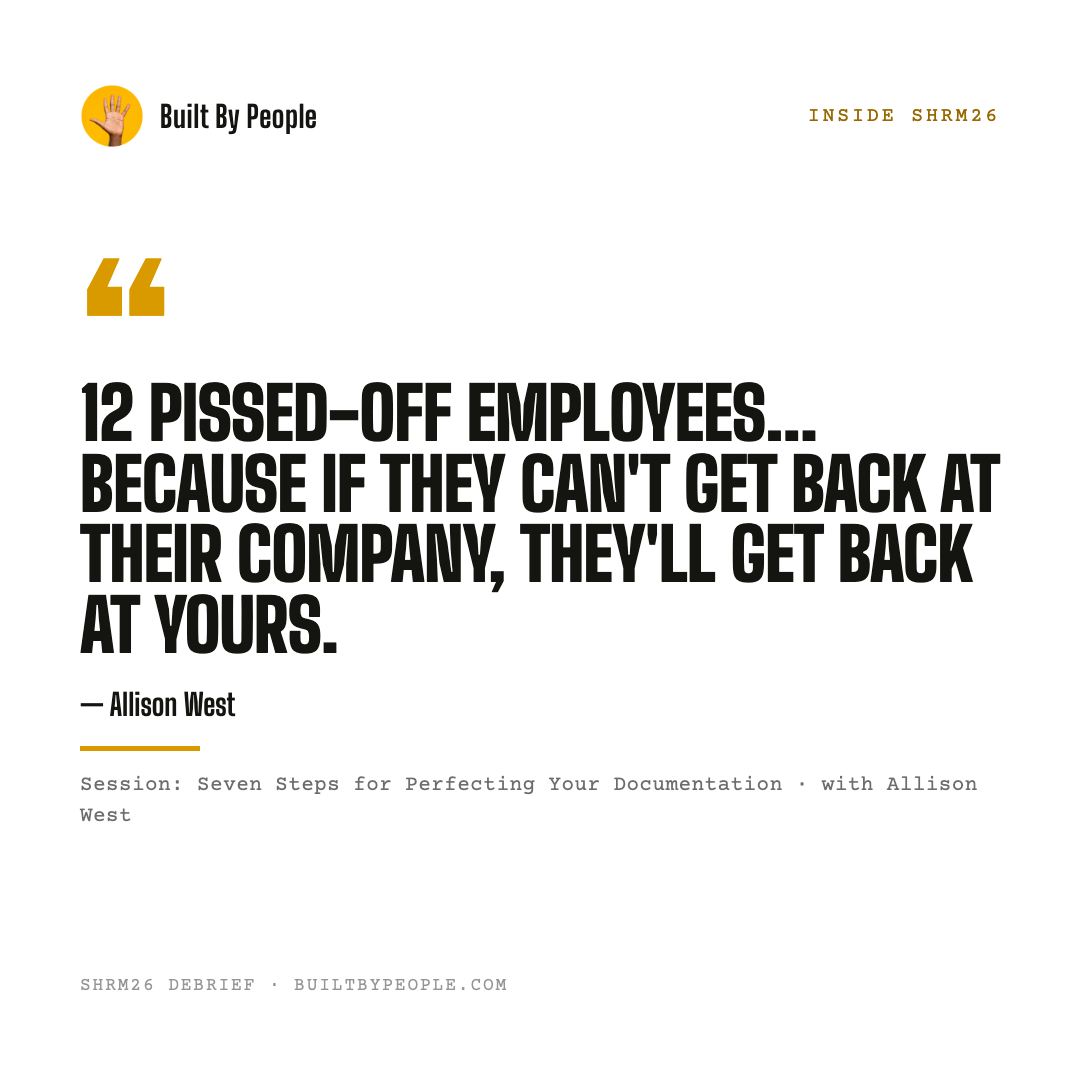
"12 pissed-off employees... because if they can't get back at their company, they'll get back at yours."
What it was about
Poor or absent workplace documentation is one of the biggest liabilities employers face in litigation, because if it isn't documented, it's treated as though it didn't happen. Good documentation must be contemporaneous, specific, two-way, and free of opinions, exaggerations, and legal conclusions.
By the numbers
Key notes
- Create contemporaneous documentation at or around the time an event happens, and always write the actual date the conversation occurred rather than the date you got around to writing it up.
- Follow a structure that includes the expectation, the behavior to change or continue, the employee's explanation, an action plan, a time frame, a follow-up plan, and (sparingly) a consequence.
- Always get the employee's explanation for why they are not meeting expectations before writing anyone up, since it demonstrates two-way procedural fairness and can surface issues like disability, FMLA, or personal circumstances managers didn't know about.
Take this back Monday
Before writing any coaching note, ask the employee for their explanation first, then log it with the actual conversation date.
If it's not documented, it's as though it didn't happen — so we're training managers to write specific, dated, two-way notes, not vague opinions.
Watch out for
- Writing documentation that expresses personal opinions, sarcasm, or judgment (e.g., 'I would have expected more from someone with your background').
- Using generalities and exaggerations like 'always,' 'never,' or 'I've told you a million times,' which destroy the writer's credibility once an employee can produce a single counterexample.
- Making legal conclusions such as labeling behavior 'harassment' or 'hostile work environment' instead of describing the specific behavior observed.
Allison West has discussed workplace harassment on PBS, CBS This Morning, and in O Magazine.