Safety Is a Talent Strategy: How HR + Security Protect People, Trust, and Brand

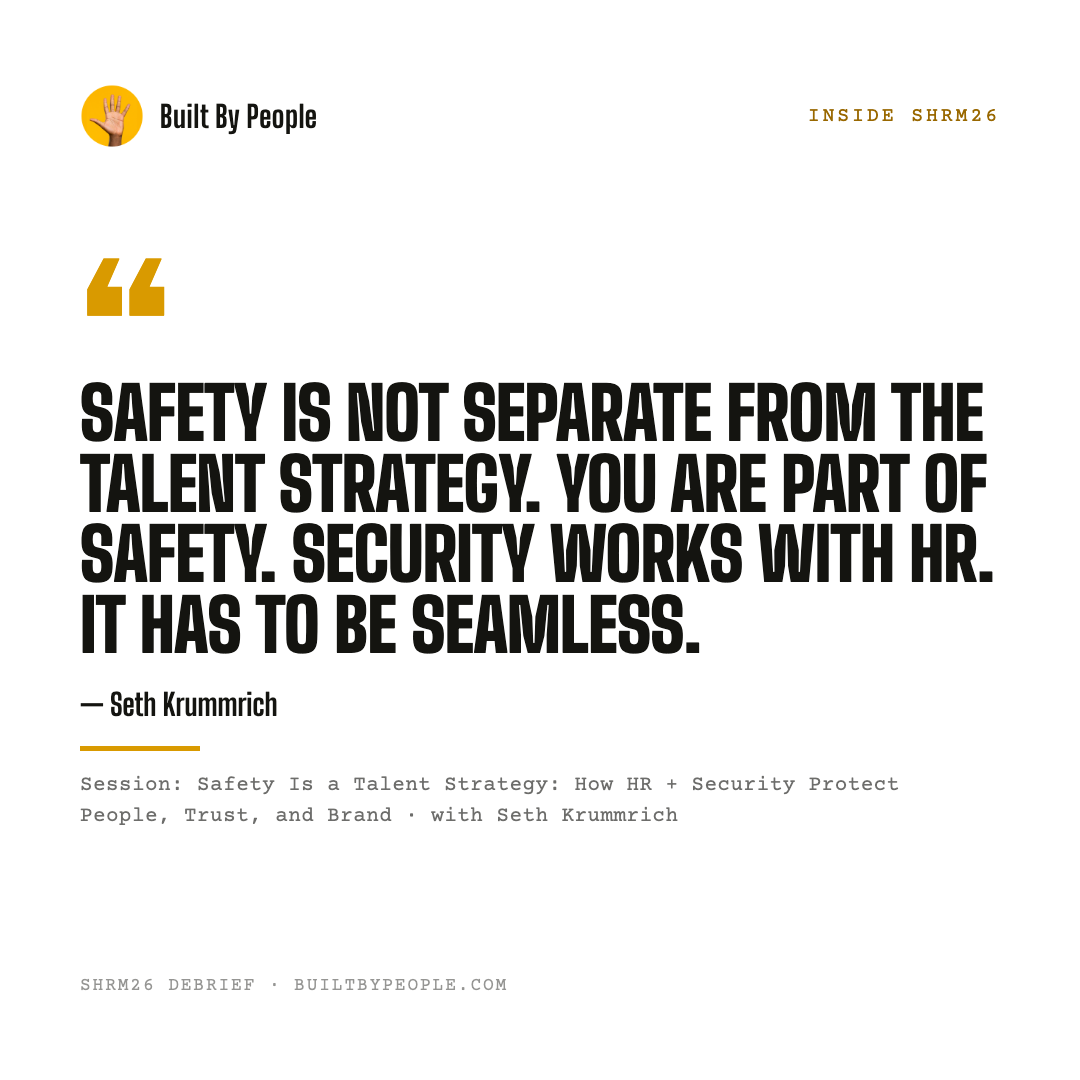
"Safety is not separate from the talent strategy. You are part of safety. Security works with HR. It has to be seamless."
What it was about
Safety is no longer a facilities function walled off from HR. In a world of rising geopolitical conflict, cyberattacks, and targeted violence against companies and leaders, HR is the essential partner to security before, during, and especially after a crisis. Organizations that fail to plan lose employee trust they may never get back.
By the numbers
Key notes
- Run a crisis response assessment: have employees fill it out cold, run a tabletop exercise, then have them retake it to reveal real gaps in personnel visibility, communications, and accountability.
- Build a clear command structure and an approved communications channel (e.g., a designated Slack channel) before a crisis, and communicate it on a 'sunny day' so employees know where to look when something happens.
- Sit down with your security lead and explicitly map out who owns what during and after a crisis so there's no ambiguity about HR's versus security's swim lanes.
Take this back Monday
Sit down with your security/facilities lead and map out who owns what during and after a crisis, then announce the designated emergency Slack channel to employees.
Safety isn't a facilities issue anymore — HR has to be security's seamless partner before, during, and after a crisis, or we lose employee trust for good.
Watch out for
- Treating safety as purely a physical/facilities issue ('the guy who locks the gates') instead of covering medical response, mental health, travel risk, and digital security.
- Improvising crisis response instead of rehearsing a written plan: 'today is not the time for improv jazz, we have to stick with the sheet music.'
- Assuming employees remember training or know the emergency communication channel without regularly re-communicating it.
A decorated Army Colonel with 28 years of service, he was Chief of Staff overseeing all Special Operations across the Middle East and Central Asia.