Return on Intelligence: Move AI ROI Beyond Cost to Competitive Advantage

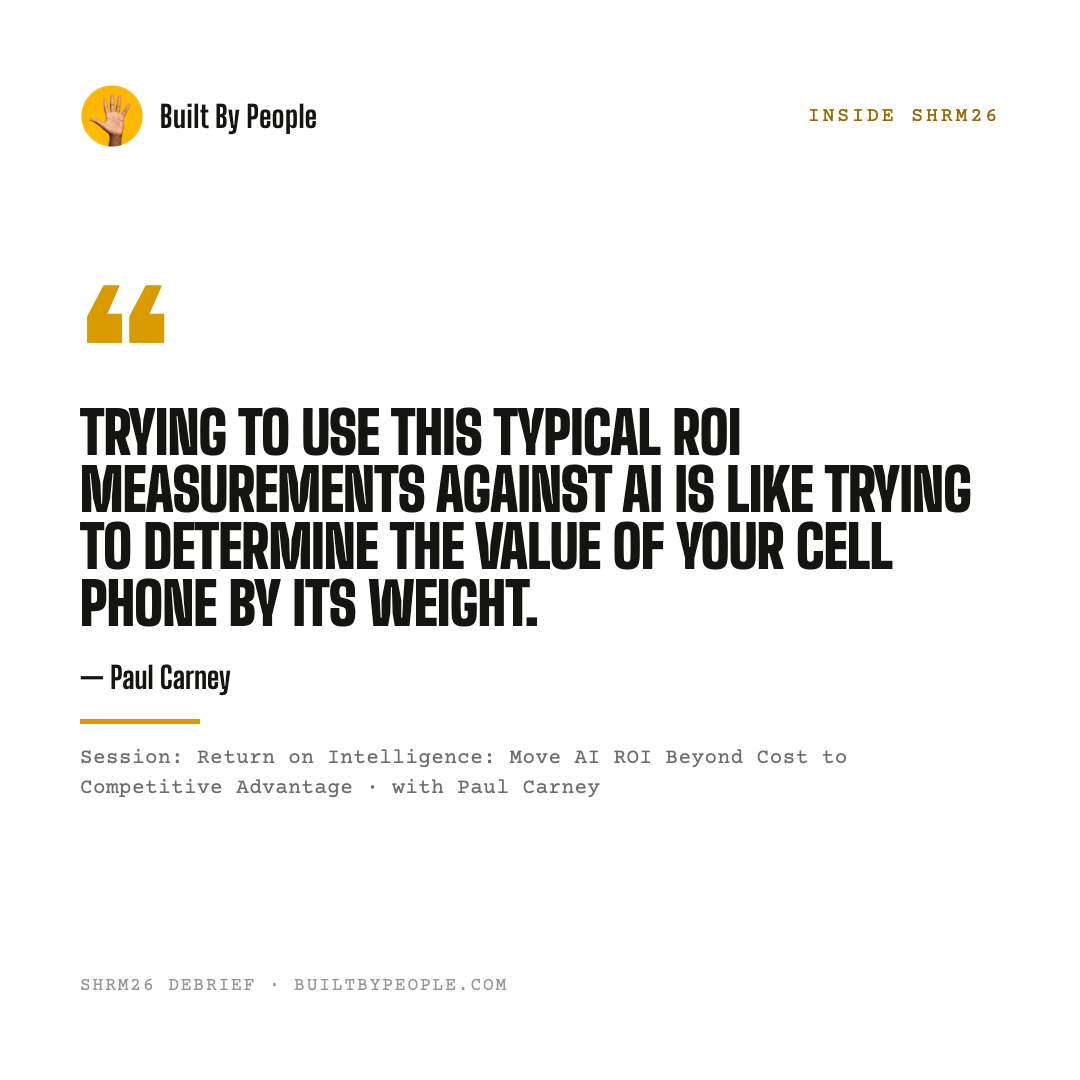
"Trying to use this typical ROI measurements against AI is like trying to determine the value of your cell phone by its weight."
What it was about
Traditional ROI math fails for AI because AI is not a depreciating asset like a building or software license: it learns, compounds, and requires an onboarding investment similar to a new employee. Organizations should replace "return on investment" thinking with "return on intelligence," tracking value across ten dimensions (time, cost, decision quality, speed to insight, capability building, discovery, defensibility, risk management, organizational learning, and confidence) instead of chasing a simple cost-savings number.
By the numbers
Key notes
- Build AI fluency in strict order: comfortable, then confident, then competent. Skipping the first two steps (as most organizations do by buying a tool and giving one training) is why adoption stalls.
- Treat AI like the smartest seven-year-old. It lacks worldly context, is extremely literal about word choice, and will confidently state things that aren't true, so manage it accordingly rather than trusting it like a senior expert.
- When AI saves you time or money, don't let the savings quietly disappear back into the budget. Reinvest it visibly (e.g., into a stalled project or new training) and tell that reinvestment story to prove value.
Take this back Monday
Pick one AI-saved time block this month and publicly reinvest it (a stalled project, extra training) instead of letting it vanish into budget.
AI ROI isn't a depreciating-asset calculation, it's more like onboarding a new hire, so we're tracking value across ten dimensions, not just cost savings.
Watch out for
- Jumping straight to the "competence" stage (buying a tool, giving one training session) without first building comfort and confidence with AI.
- Measuring AI adoption with simple compliance metrics (e.g., logins, mandatory training completion): employees will game the metric (KPMG example: logging in and out just to register a session) while gaining no real value.
- Treating AI ROI like ROI on a building or software license, a fixed, amortizable asset, when AI is dynamic, compounding, and closer to onboarding a new employee than installing a tool.
The former Chief HR Officer turned AI educator and his wife have earned a Level 2 Award in Wine from the Wine & Spirit Education Trust.