Redesigning Work in the Age of AI: Unlocking Productivity and Human Potential

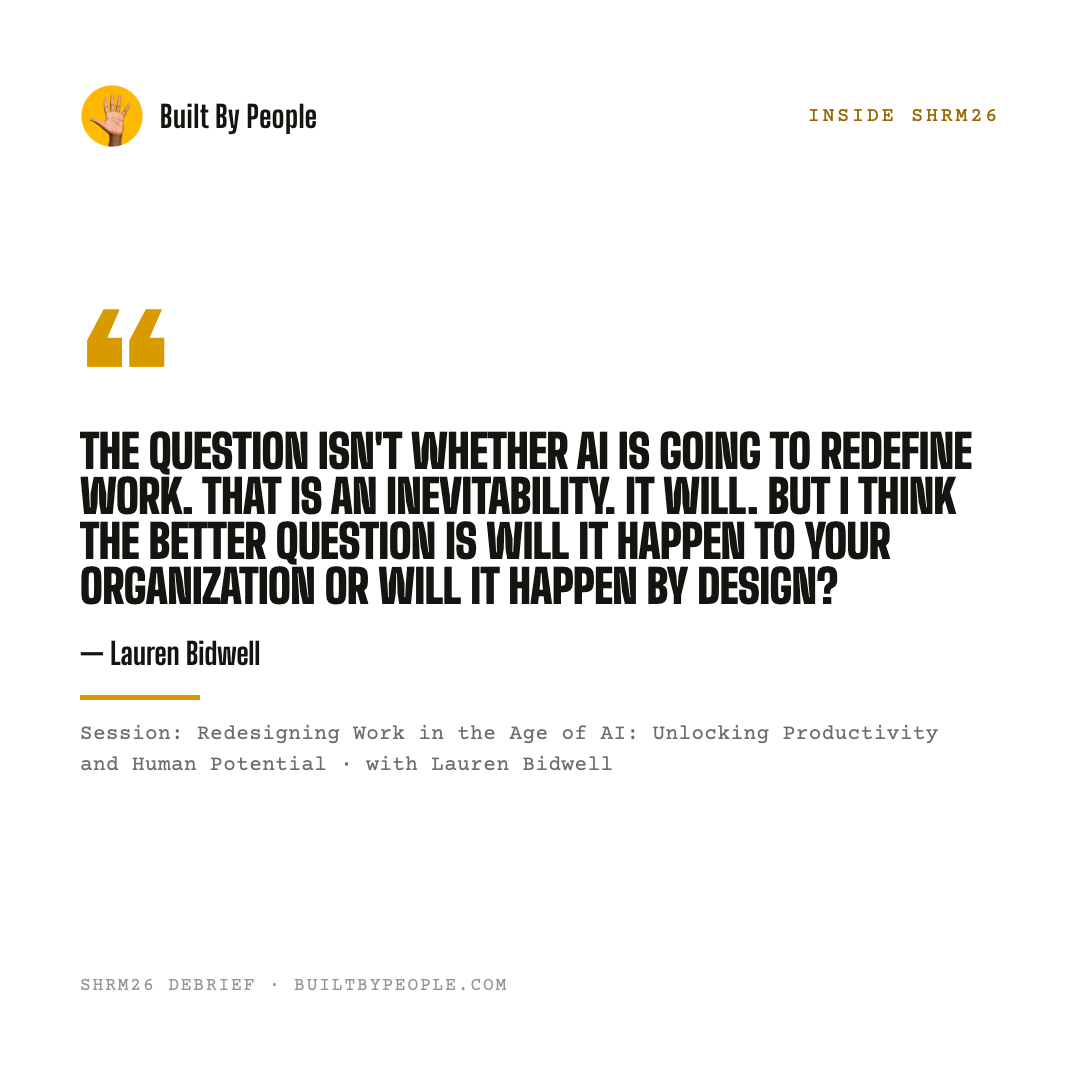
"The question isn't whether AI is going to redefine work. That is an inevitability. It will. But I think the better question is will it happen to your organization or will it happen by design?"
What it was about
AI is inevitably redefining work, so the real choice for organizations is whether that redesign happens deliberately, guided by an evidence-based model that balances human and AI strengths. The alternative is redesign by default, leaving employees confused and roles drifting without guardrails.
By the numbers
Key notes
- Start work redesign by writing a future-based job purpose statement that captures what outcome the role needs to deliver going forward, not what it does today.
- Deconstruct jobs into component tasks at a useful level of granularity, and validate that task list with the subject matter experts actually doing the job.
- Assess each task against a strengths framework (judgment vs. rule-based, data quality, emotional sensitivity, etc.) to decide whether AI, humans, or a combination should own it, rather than defaulting to whichever technology is available.
Take this back Monday
Pick one role, write its future-focused purpose statement, then sort its tasks by whether AI, a person, or both should own each one.
AI redefining our jobs is inevitable. The only real choice is whether we redesign roles by design or let it happen by default.
Watch out for
- Letting employees redesign their own jobs informally and unilaterally without organizational guidance, which is happening for roughly half of all task changes today.
- Chasing 'minutes saved' or time-savings as the primary measure of AI success instead of redesigning what work should be done at all.
- Assuming a task should go to AI just because AI can technically do it (the 'AI can vs. AI should' distinction), for example letting AI deliver a post-interview rejection or negotiate salary.
She holds a Ph.D. in Experimental and Decision-Making Psychology and has consulted with hundreds of customer organizations worldwide on AI's impact on employee experience.