Red Flags, Quiet Risks: HR Strategies for Detection, Documentation, and Trauma-Informed Response
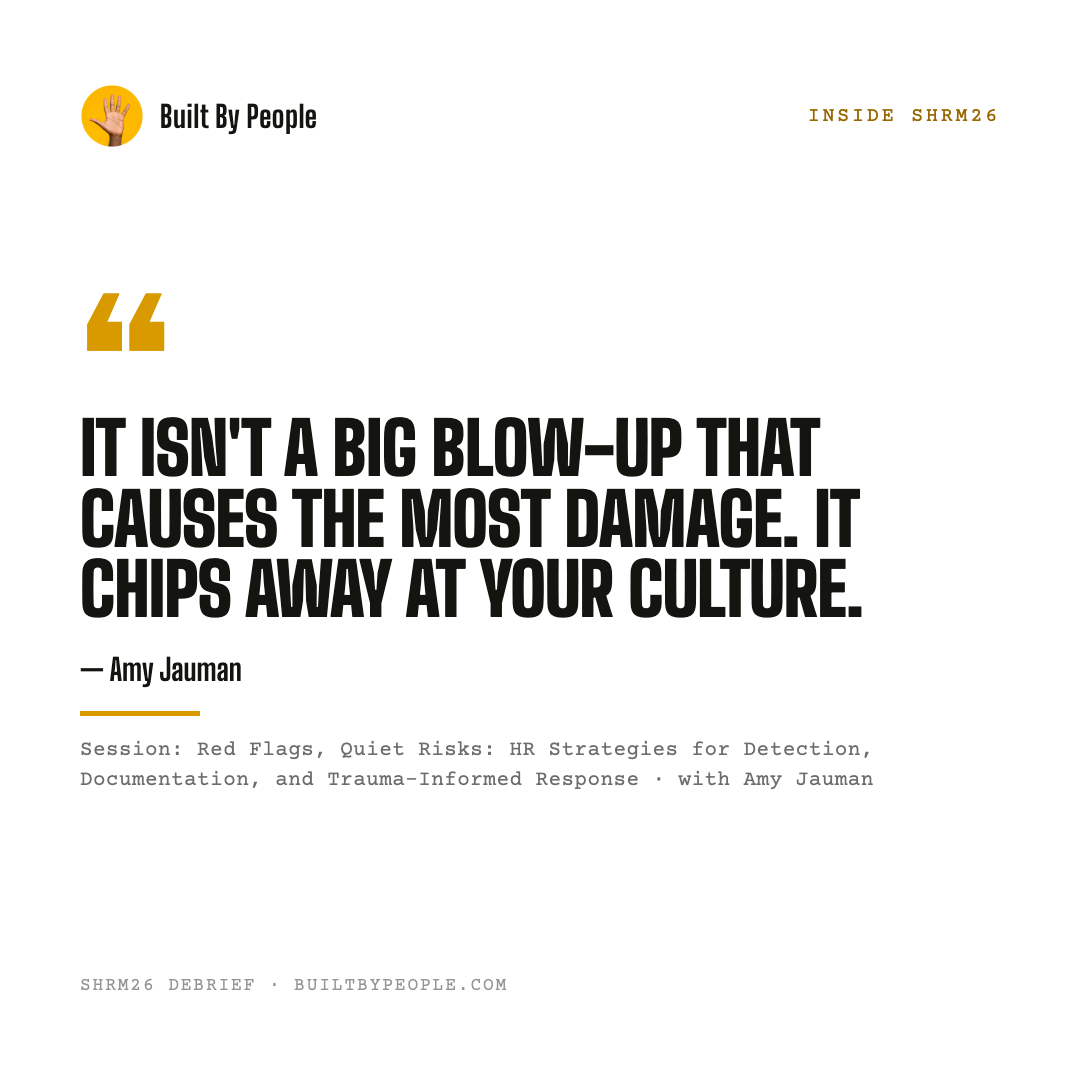
"It isn't a big blow-up that causes the most damage. It chips away at your culture."
What it was about
High-conflict personalities in the workplace cause slow, cumulative damage rather than one dramatic blow-up. HR professionals must learn to observe behavioral patterns (not diagnose), document early, and use trauma-informed practices to intervene before a breaking point forces reactive action.
By the numbers
Key notes
- Focus on observable behaviors rather than attempting to diagnose someone as a narcissist, sociopath, or psychopath: diagnosing a coworker is both inaccurate and legally risky.
- Start documentation the moment you notice a minor pattern (a 'yellow flag'), not after a major incident, so you have a paper trail if action ever becomes necessary.
- Translate the cultural cost of a high-conflict personality into language leadership already understands: tie it to turnover of top performers, productivity loss, and financial risk, since leadership often only sees the numbers.
Take this back Monday
Start a private note the moment you spot a 'yellow flag' behavior: don't wait for a blow-up to begin documenting.
The real damage isn't one big blow-up: a high-conflict personality chips away at culture over time, so we document early, not after a crisis.
Watch out for
- Waiting for a single big, explosive incident before intervening instead of acting on early red flags.
- Assuming a person is fine simply because they are a high performer, which causes leadership and HR to excuse or overlook concerning behavior ('they're so good at their job').
- Diagnosing coworkers with clinical labels (narcissist, sociopath, etc.) instead of documenting specific behaviors.
She co-wrote a true-crime book on the Dirty John case and holds a graduate certificate in crime analysis from Boston University.