Re-Engage, Rebuild, Return: A Better Path to Work After Illness or Injury
 & Bryon Bass
 & Julie Hocker
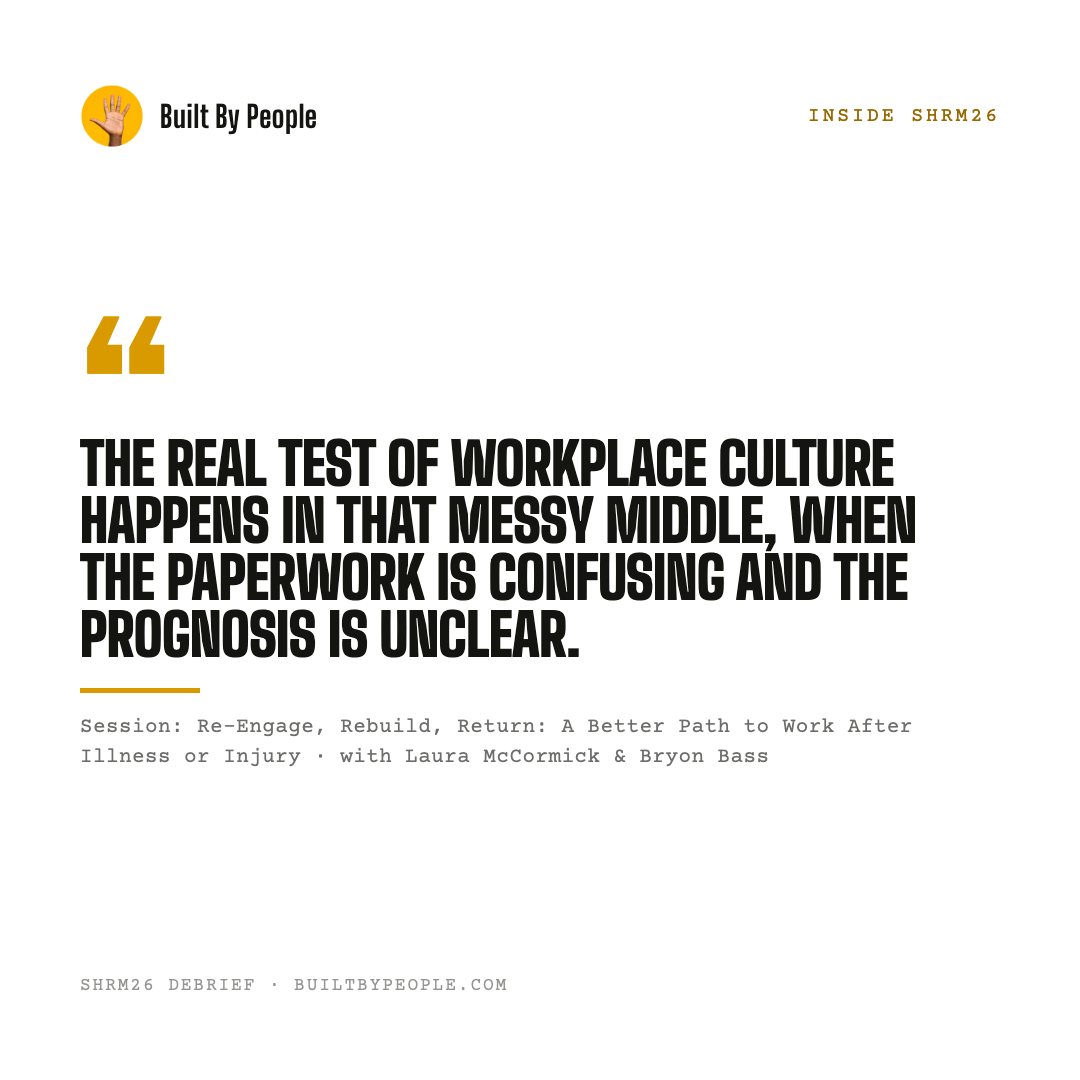
"The real test of workplace culture happens in that messy middle, when the paperwork is confusing and the prognosis is unclear."
What it was about
Stay-at-work and return-to-work is not a compliance checkbox but a defining act of organizational culture; early, coordinated, human-centered communication between employer, employee, and provider keeps people attached to work, protects the business, and dramatically improves the odds of a successful return.
By the numbers
Key notes
- Build a formal return-to-work program defined as a repeatable operating model with clear ownership, not just a policy line in the employee handbook.
- Act early: the longer someone stays out of work, the less likely they are to return, so intervene within the first weeks of a leave rather than waiting for a crisis point.
- Extend return-to-work practices to non-occupational (non-workers'-comp) leaves, not just workplace injuries, to avoid an equity gap in how employees are supported.
Take this back Monday
Reach out to any employee on leave this week: don't wait for them to come back healed; offer temporary reassignment or modified duty now.
By week 12 out of work, an employee's odds of returning drop to half — so our return-to-work process needs to start in week one, not month three.
Watch out for
- Assuming a written policy in the handbook counts as a 'formal' program when there is no actual coordinated, repeatable process behind it.
- Letting return-to-work protocols apply only to workers' comp/occupational injuries while non-occupational leaves go unsupported, creating an equity gap.
- Believing the myth that bringing an employee back with restrictions guarantees a workers' comp claim: this is generally untrue when communication and accommodation processes are in place.
Julie Hocker testified before the EEOC in 2021 on the civil rights impact of COVID-19 before becoming Assistant Secretary of Labor.