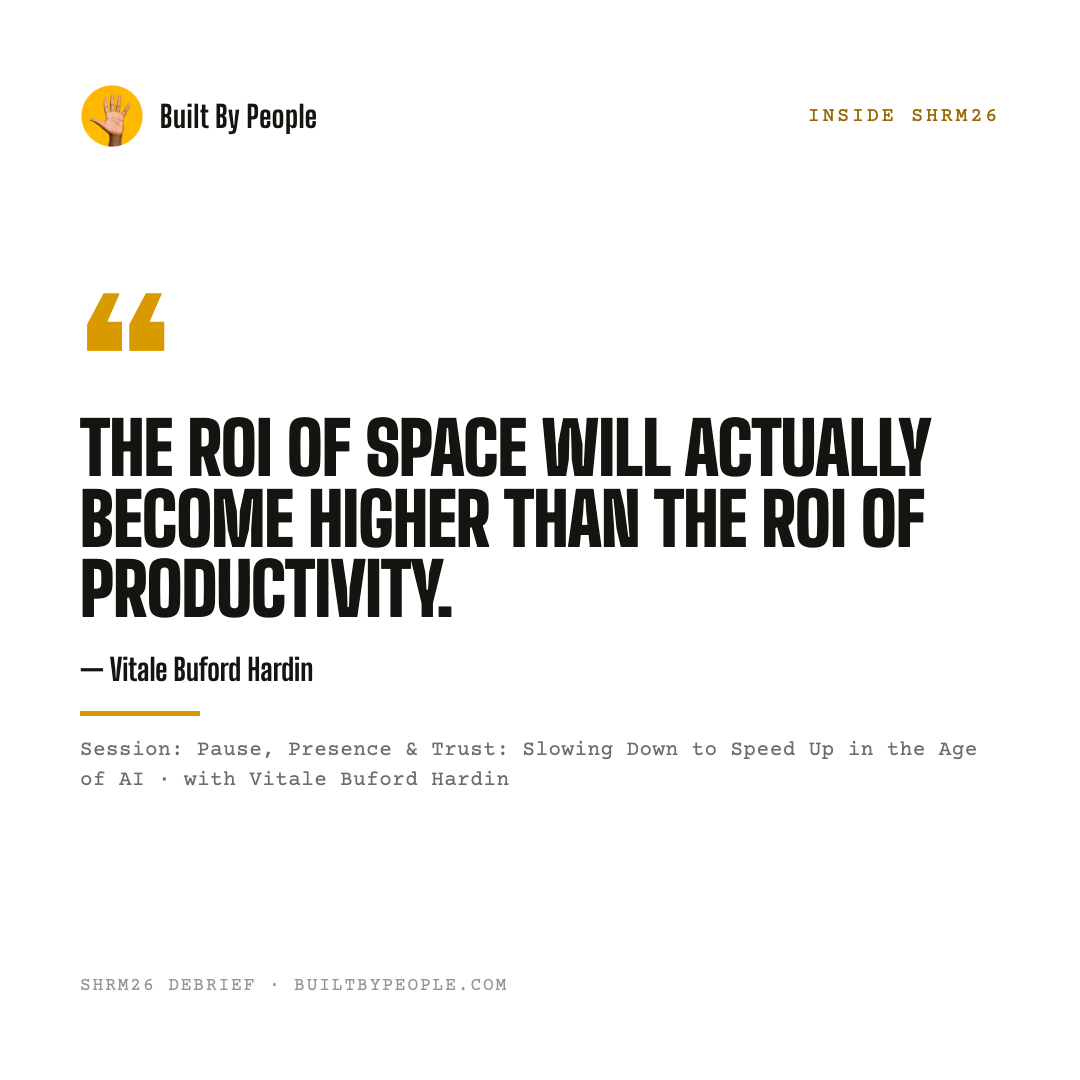
Pause, Presence & Trust: Slowing Down to Speed Up in the Age of AI

"The ROI of space will actually become higher than the ROI of productivity."
What it was about
AI increases speed and productivity, but organizations only succeed with it by amplifying human traits like trust, critical thinking, and connection alongside it. Skipping that human element, jumping straight to organizational-level AI rollout without building individual and team trust first, is why most AI initiatives fail.
By the numbers
Key notes
- Move through all three levels of AI integration in order: individual ownership, then team integration, then organizational transformation, rather than skipping straight to level three.
- Address the three Cs of AI adoption (competence, control, connection) explicitly in your communication strategy or employees will resist AI initiatives.
- Require that people form and can articulate their own rationale or first draft before consulting AI, so critical thinking and decision-making skills don't atrophy.
Take this back Monday
Before rolling out any new AI tool, run a team session addressing competence, control, and connection concerns to head off resistance.
Ninety to ninety-five percent of enterprise AI initiatives fail on ROI because they skip building trust before rolling AI out organization-wide.
Watch out for
- Jumping directly to organizational-level AI transformation (level three) without first building individual confidence and team-level trust and practices.
- Treating AI outputs as the 'perfect' answer and defaulting to them instead of trusting one's own instinct, which reinforces workplace perfectionism.
- Using AI purely as an extraction/vending-machine tool (generic prompt in, copy-paste answer out) instead of a listening/pattern-recognition tool, producing generic 'AI average' output that erodes brand and personal voice.
She led three university research studies on workplace perfectionism and wrote a 2020 memoir, Addicted to Perfect, about overcoming it herself.