SHRM26 Debrief · AI, Data & Tech · #3613
Leading By Example: Aligning HR, Leadership, And Employees for Responsible AI Adoption
with Vinay Gidwaney & Meagan Karry
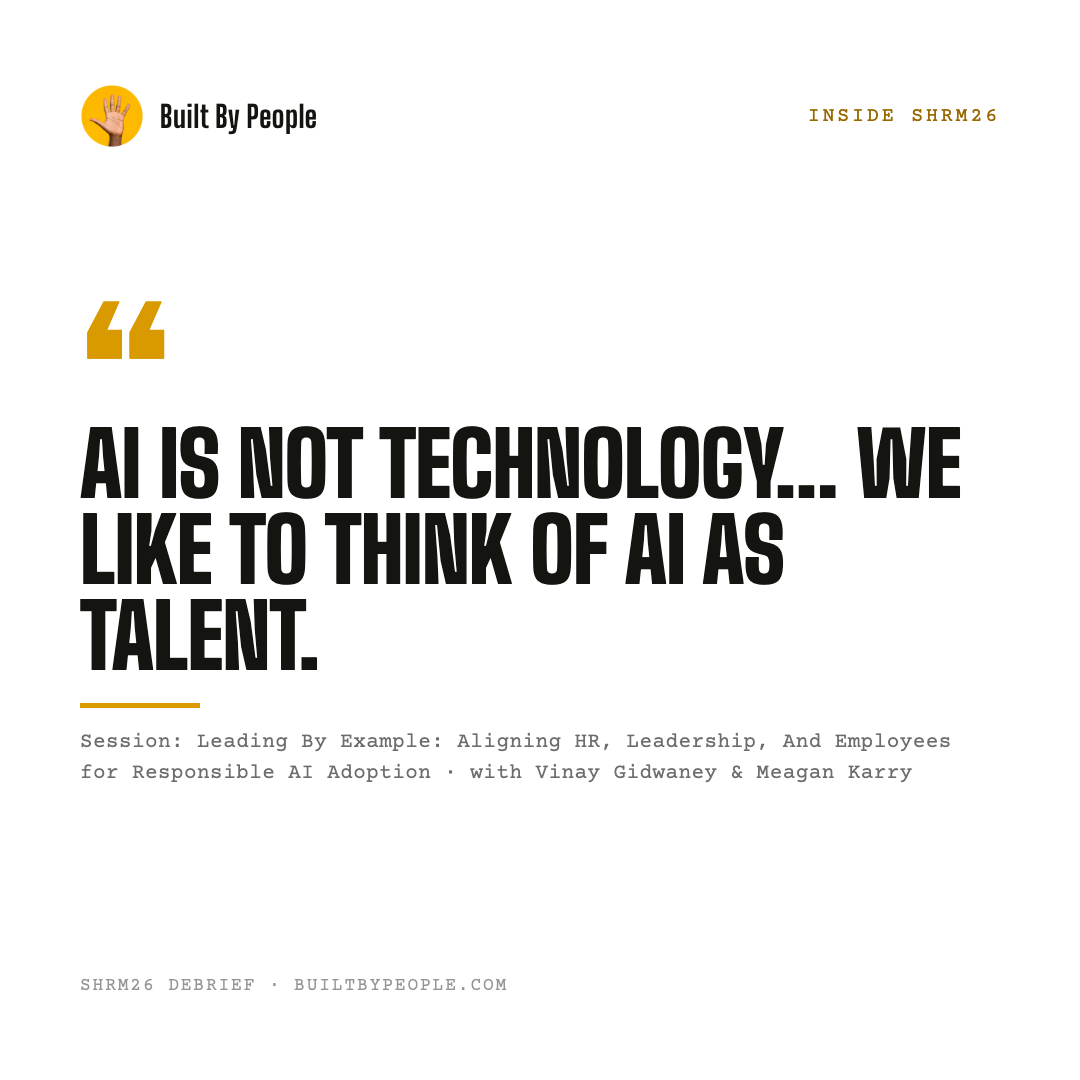
& Meagan Karry"AI is not technology... we like to think of AI as talent."
What it was about
AI should be treated as a new form of talent rather than a piece of technology, and HR — not IT. is best positioned to lead its adoption because HR's core mission is elevating human potential, not just driving usage metrics.
By the numbers
92 million jobs projected to be displaced by 2030
AI's projected impact on the workforce
over 80% of usage of AI on a regular basis
OneDigital's current internal AI adoption rate, after breaking through the plateau
fired 90% of their call center agents
Klarna's CEO's stated plan to replace call center staff with AI (the 'Klarna effect')
Key notes
- HR should lead AI adoption as a workforce-transformation initiative, in close partnership with IT and product, rather than ceding ownership to IT.
- Treat AI like talent: write a job description for what you want the AI to do, then progress it through a hiring-style pathway from 'intern' to 'apprentice' to a named 'coworker' with an assigned human supervisor.
- Put a governance policy in place before deploying any AI tool, document it in the handbook, and communicate it repeatedly, because unprotected employee use of free AI tools puts company data at risk.
The contrarian takeThe speaker argues that tech-industry leaders like Elon Musk, Mark Zuckerberg, and Sam Altman (whom he calls 'deeply flawed individuals, usually always men') shouldn't be the ones deciding how society handles AI. He suggests vendor claims that a model is 'too powerful to release' are partly self-serving hype meant to boost stock price ahead of an IPO.
Take this back Monday
Do this for your team
Draft a one-page AI usage policy for the handbook before any team member adopts a free AI tool with company data.
Say this in your next leadership meeting
AI should be treated as talent HR onboards and supervises, not IT software rolled out for usage metrics.
Watch out for
- Rolling AI out purely for cost-cutting/efficiency and mass-firing staff, then having to rehire once quality and retention suffer (the 'Klarna effect').
- Deploying a generic chatbot license (e.g., Copilot) company-wide without training it on company-specific knowledge, causing usage to stall around 20% (the 'Copilot plateau').
- Letting IT own the AI rollout, since IT optimizes for login/usage metrics rather than actual human value creation.
Fun fact · Vinay Gidwaney
Before OneDigital, he ran tech for CIC Health, scaling up COVID-19 testing and mass vaccination sites across Massachusetts.
If this landed, see these
↳ Go deeperHR Executive Insights: A CHRO’s View on Owning the Digital Workforce, Operationalizing Generative and Agentic AI, and the Future of WorkA CHRO's field notes on actually operationalizing the AI-as-coworker model this session proposes.⇄ The counterpoint2026 State of AI in the WorkplaceReal adoption is messier than a clean hiring pathway: usage and shadow AI vary wildly by job level.✦ The unexpected oneIf Leadership is a Game, These Are the RulesThe same rule, grow others to grow yourself, applies whether you're managing a person or an AI coworker.