Human Connection, Upgraded: The Future of Virtual Belonging

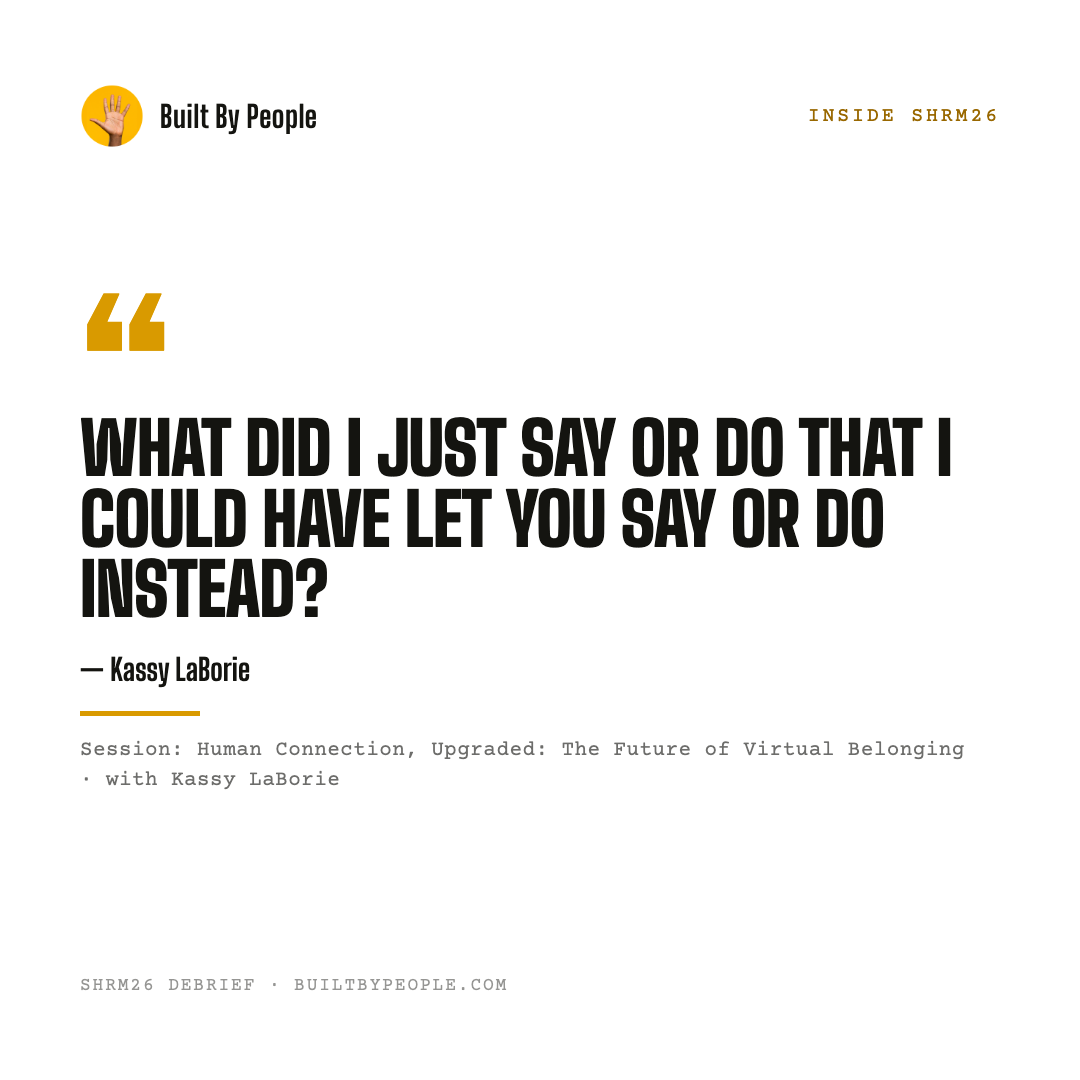
"What did I just say or do that I could have let you say or do instead?"
What it was about
Engagement in virtual, hybrid, and in-person settings comes down to one design principle: constantly ask 'what am I saying or doing that I could let the audience say or do instead,' and use simple structured techniques (image, quote, song, and list "connects") plus AI to design for participation rather than lecture through content.
Key notes
- Redesign any presentation moment by asking 'what am I saying or doing that I could let them say or do instead,' rather than defaulting to lecture-then-Q&A.
- Use an 'Image Connect' activity (participants pick a numbered image and explain their choice) as a low-pressure way to open introductions online or in person.
- Use a 'Quote Connect' (participants read several on-topic quotes and discuss which resonates) for more reflective, bounded conversation than an open-ended prompt.
Take this back Monday
In your next team meeting, replace one lecture slide with a 'List Connect': have people mark which item they want discussed before you talk.
Engagement isn't about better content, it's asking 'what am I saying or doing that I could let them say or do instead.'
Watch out for
- Defaulting to 'go through all my slides, then take questions at the end' instead of building in points where the audience says or does something throughout.
- Using screenshot-heavy training materials to teach software instead of just letting people click the actual buttons and learn by doing.
- Treating on-camera requirements as a rigid default without considering the pressure it puts on attendees.
She architected Dale Carnegie Training's $4 million digital business and was an early pioneer at Webex University.