Future Proofing Your Health Benefits: A Panel Discussion on Multi Year Planning and High Performance Program Design
 & Stephanie Porrino
 & Chelsea Ryckis
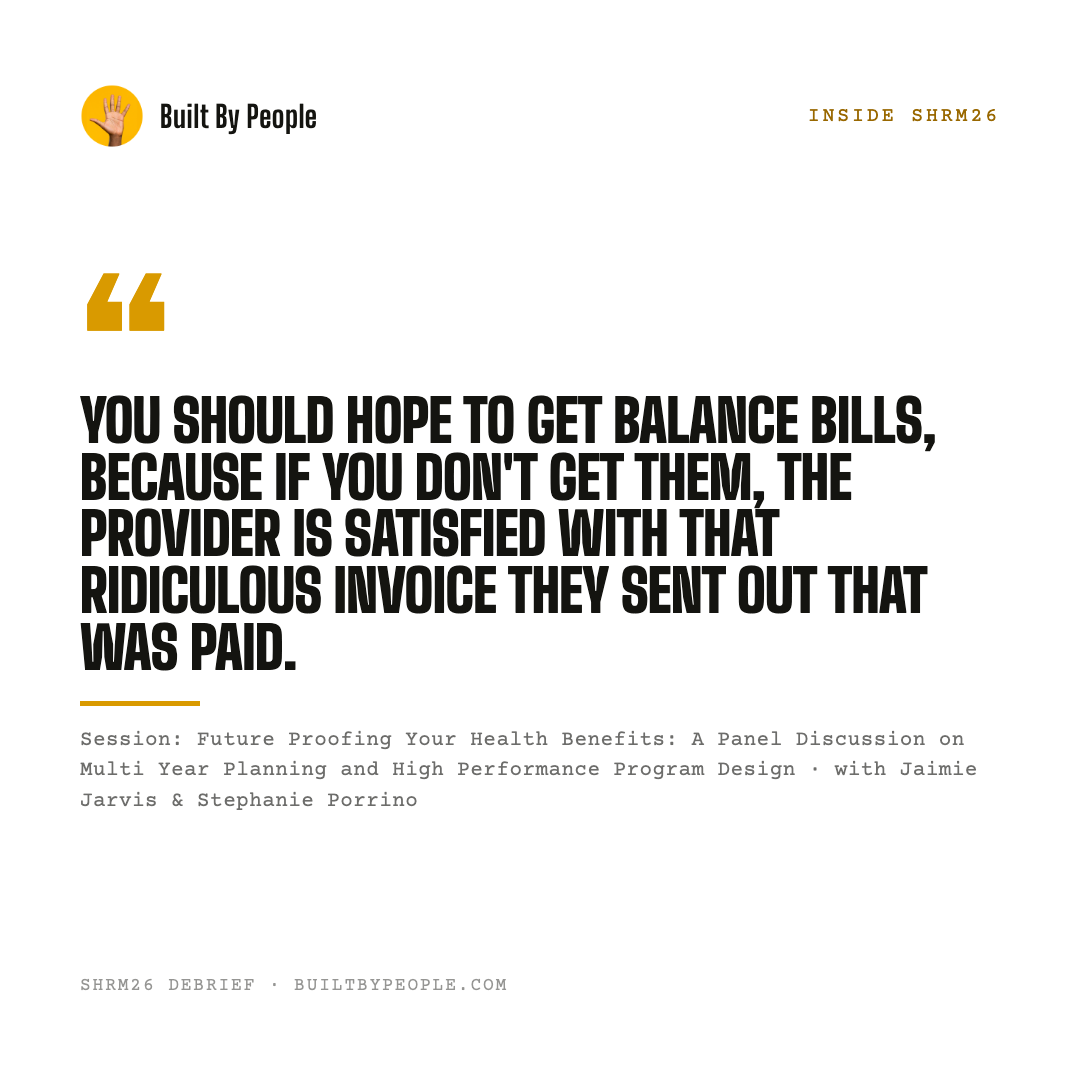
"You should hope to get balance bills, because if you don't get them, the provider is satisfied with that ridiculous invoice they sent out that was paid."
What it was about
Employers can escape the reactive, ever-worsening healthcare renewal cycle by becoming true fiduciary governors of their self-funded health plan. That means unbundling the four moving parts (PBM, network, TPA, stop loss), demanding claims-level data, and only working with vendors who win when the plan wins, rather than passively renewing with the same carrier and broker year after year.
By the numbers
Key notes
- Understand the four separate moving parts of any health plan (PBM, network, TPA, and stop loss) and manage or benchmark each independently rather than treating the plan as one bundled black box.
- Demand to-the-penny claims data (not summary carrier reports) so you can identify trends, audit invoices, and make predictive/data-driven plan decisions.
- Consider a network replacement / reference-based pricing model, which prices claims off a percentage of Medicare rather than accepting inflated hospital billed charges with a token discount.
Take this back Monday
Email your broker asking for to-the-penny claims data, not summary reports. Their response tells you if they're the right partner.
We're not just renewing our health plan anymore — we're separately managing the PBM, network, TPA, and stop loss so no vendor profits when costs go up.
Watch out for
- Relying on a broker who brings only 2-3 BUCA carriers (Blue Cross, United, Cigna, Aetna) as "competition" each renewal instead of evaluating all four plan functions separately.
- Accepting carrier claim summaries (top 10 drugs, one-page spend reports) as sufficient data instead of demanding to-the-penny, per-claim data.
- Compensating brokers/advisors through commission tied to premium size, which incentivizes them to push risk transfer (the most expensive option) rather than risk avoidance or reduction.
A traumatic brain injury during her college sports career derailed her plan to attend medical school — and led her to found Ethos Benefits instead.