SHRM26 Debrief · Strategic HR, Organizational Design & Change Management · #2694
From Jobs to Capabilities: How Organizations Actually Scale Skills-Based Workforce Models
with Abdulrahman Alsheail
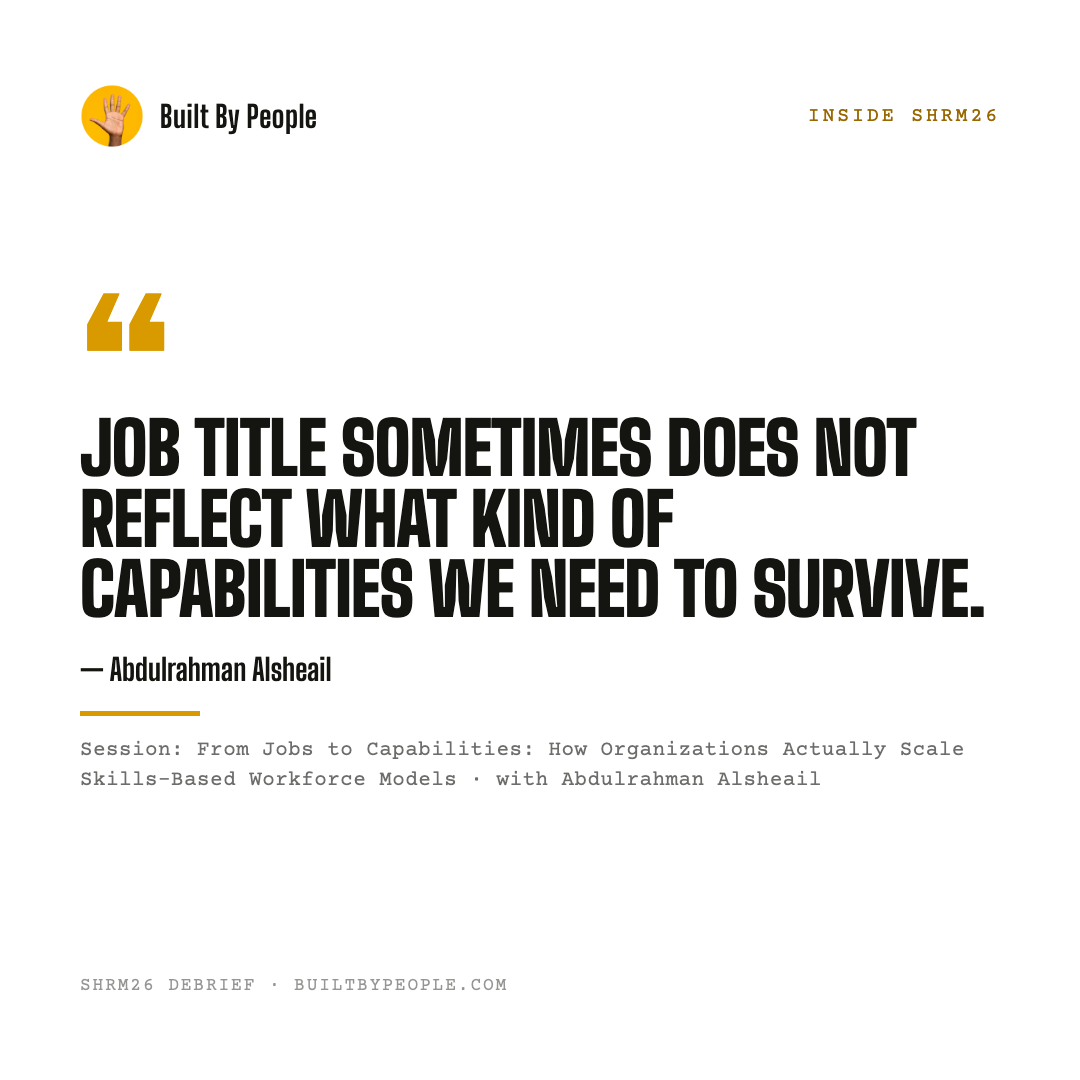
"Job title sometimes does not reflect what kind of capabilities we need to survive."
What it was about
Organizations fail at skills-based transformation when they try to build massive, standalone skills taxonomies disconnected from business strategy; instead, jobs should stay as the formal structural anchor while a targeted "capability intelligence layer" (built small, tied to 3-5 business priorities, and governed) is added to improve specific HR decisions like workforce planning, learning, and mobility.
By the numbers
2 out of 80
HR leaders (per a Gartner survey) reported they were successful in creating a skill-based model that was adopted (i.e., only 2%)
39%
of core skills expected to change by 2030, per the World Economic Forum
7 in 10
business leaders believe their competitive strategy should be based on speed and agility (cited poll/research)
Key notes
- Before building any skills taxonomy or competency model, ask stakeholders what specific HR decisions they want to improve rather than building a generic library first.
- Start small: pick 3-5 business priorities or gaps and define 3-6 critical capabilities tied directly to them, rather than mapping skills for the whole enterprise.
- Use the sequence jobs -> skills -> capabilities -> decisions, keeping job titles, grades, and budgets intact as the formal anchor while capabilities act as an intelligence layer on top.
The contrarian takeThe speaker argues against the popular idea of eliminating job titles altogether and replacing them with capability-based titles (e.g., 'scenario-based readiness specialist'), calling this approach too risky for most organizations despite some researchers actively exploring it; instead he insists jobs should remain the formal anchor and capabilities should only be an added intelligence layer.
Take this back Monday
Do this for your team
Pick one open headcount request and run build/buy/borrow/automate before approving it — skip the reflexive hire.
Say this in your next leadership meeting
Skills taxonomies fail when they're built as thousand-skill libraries disconnected from strategy — we're starting with 3-5 priorities instead.
Watch out for
- Building a massive, enterprise-wide skills taxonomy or competency model (thousands of skills) before linking it to any specific business outcome, producing a very expensive, underused document.
- Buying a skills/competency software platform before decision ownership and governance are clearly defined.
- Applying skills-based models to pay, grade redesign, or employment-relation changes before the organization has sufficient maturity.
If this landed, see these
↳ Go deeperMaximizing the Power of Assessments in HRShows how to make the capability layer earn its keep: tie every assessment or data point to one decision, not just a dashboard nobody uses.⇄ The counterpointThe Chief Disruption Officer: Architecting Tomorrow’s Workforce EcosystemPushes the opposite instinct: don't just add an intelligence layer on top of jobs, become the disruption officer who redesigns the workforce ecosystem itself.✦ The unexpected oneAfter The Complaint: The Decisions That Create Retaliation LiabilitySame structural insight in a different domain: it's not one big decision but the sequence of smaller ones that determines the outcome, here in retaliation liability.