Fair Pay, Lean Resources: Compensation Strategies for Small & Midsize HR Teams

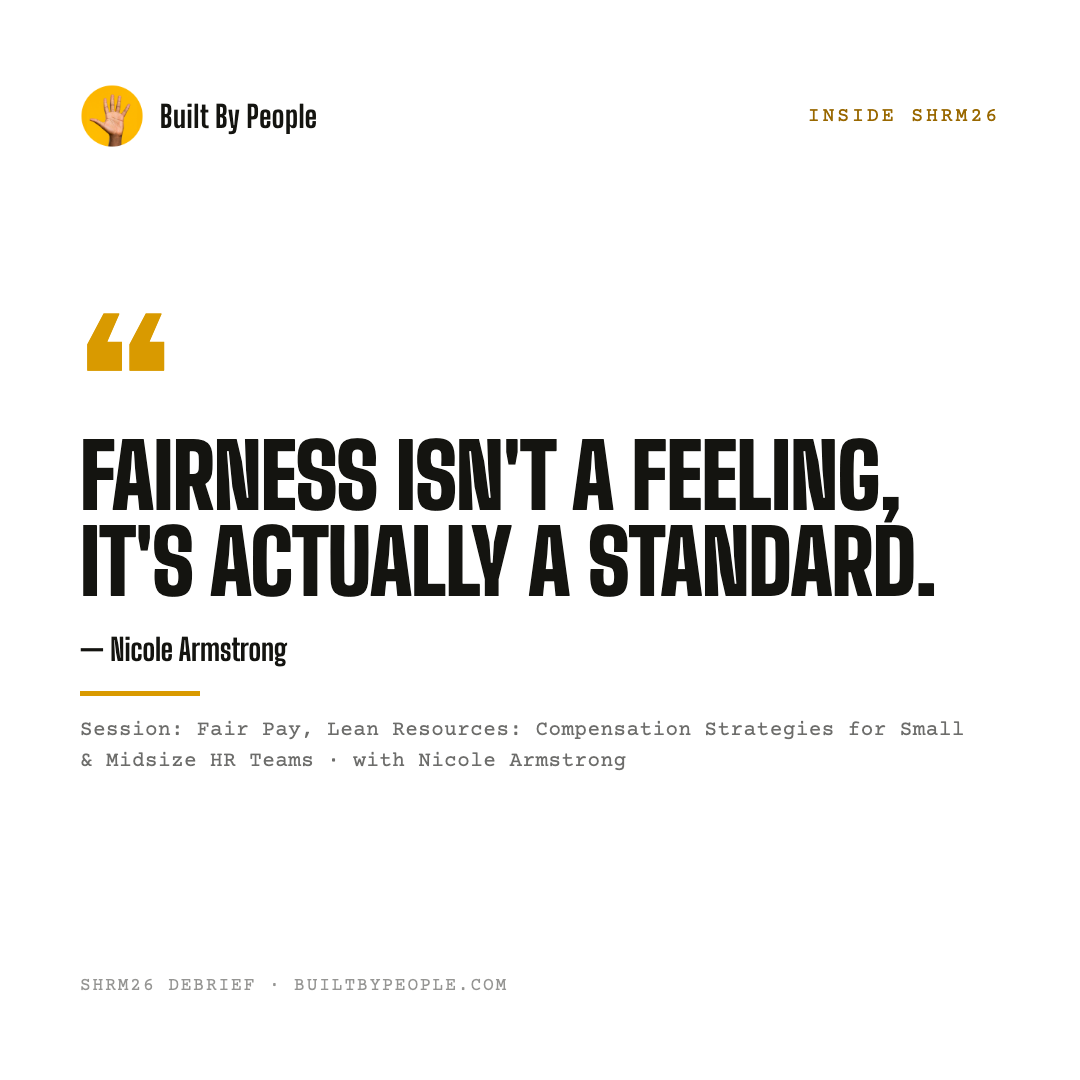
"Fairness isn't a feeling, it's actually a standard."
What it was about
Small and midsize organizations don't need a full comp department to build fair, defensible pay — they need a compensation philosophy and a repeatable framework of four lenses (market rate, internal role value, skills-based value, sustainable wage) that turns pay decisions from reactive one-offs into an intentional system.
By the numbers
Key notes
- Write down an explicit compensation philosophy that answers what pay exists to achieve, which roles/skills are most critical to strategy, and what rule to use when market data conflicts with internal value — without this, market data becomes the default by inertia.
- Evaluate roles through four lenses (market data, internal role value, skills-based value, sustainable/living wage) instead of relying on market survey data alone, since market data can't see a role's operational criticality or carry forward historical bias.
- Score internal role value by gathering three perspectives: HR, the role's manager, and employees in the role, against 4-5 dimensions (mission impact, revenue generation, risk/compliance) using a simple scoring sheet.
Take this back Monday
Pick 3-5 roles, plot role value vs. pay risk, and run the high-value/high-risk ones through the four-lens pay review first.
Fair pay isn't about market data alone — it's a system of four lenses: market rate, internal value, skills, and living wage.
Watch out for
- Treating pay transparency (disclosing ranges, communicating philosophy) as sufficient on its own — it makes existing unfairness more visible rather than fixing the underlying system.
- Defaulting to market rate as the sole basis for pay, which prices the job title's history rather than the role's actual operational value and can carry forward historical bias against work traditionally done by women and people of color.
- Writing skill requirements as vague labels like 'team player' or 'strong communication skills' that aren't specific enough for two managers to evaluate consistently or connect to pay.
Nicole Armstrong is a Goldman Sachs 10,000 Small Businesses graduate who launched the nation's first employer certification for workplace equity.