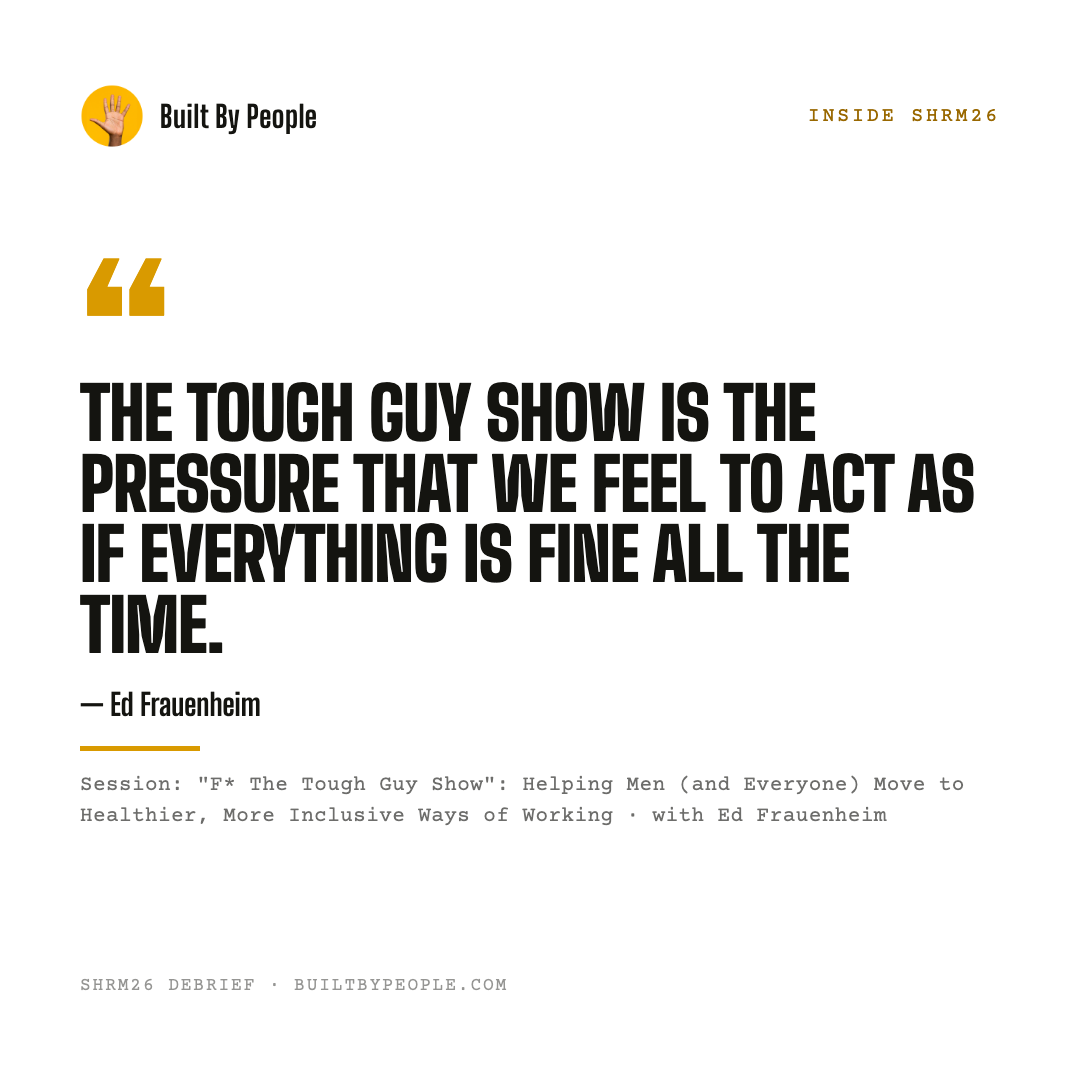
"F* The Tough Guy Show": Helping Men (and Everyone) Move to Healthier, More Inclusive Ways of Working

"The tough guy show is the pressure that we feel to act as if everything is fine all the time."
What it was about
The 'tough guy show,' confined masculinity's stoic, self-sufficient, always-on toughness, damages men, teams, and organizations by killing psychological safety, collaboration, and belonging. Replacing it with 'liberating masculinity' and six practices (the six Cs) builds healthier, more inclusive workplaces.
By the numbers
Key notes
- Recognize the tough guy show as a script: the pressure to be stoic, invincible, and self-sufficient at all times. Name it explicitly with your team so it can be discussed rather than silently performed.
- Practice the six Cs (curiosity, courage, compassion, connection, commitment, contemplation) as a personal and team development framework for moving from confined to liberating masculinity.
- Build psychological safety by modeling vulnerability yourself first — leaders who admit struggle make it safer for others to speak up with ideas, questions, or concerns.
Take this back Monday
Run a team self-assessment on the six Cs (curiosity, courage, compassion, connection, commitment, contemplation) and have each person write one action to close their gap.
53% of workers report burnout, and toxic "tough guy" cultures contribute to roughly 120 excess deaths a year — psychological safety is a retention and health issue, not just a nice-to-have.
Watch out for
- Assuming toughness must be constant rather than situational, which sets people up to feel like failures against impossible superhuman standards.
- Treating vulnerability or asking for help as weakness, which suppresses disclosure of mental health struggles until they become crises.
- Stereotyping who is or isn't performing the tough guy show based on appearance (e.g., assuming a bearded, muscular man embodies it), which perpetuates the same confined categories being critiqued.
He co-authored a study of 10,000 managers and 75,000 employees for his book A Great Place to Work For All.