Empowering Employees with ICHRAs: A Personalized Approach to Health Benefits
 & Anthony Murphy
 & Hunter Foster
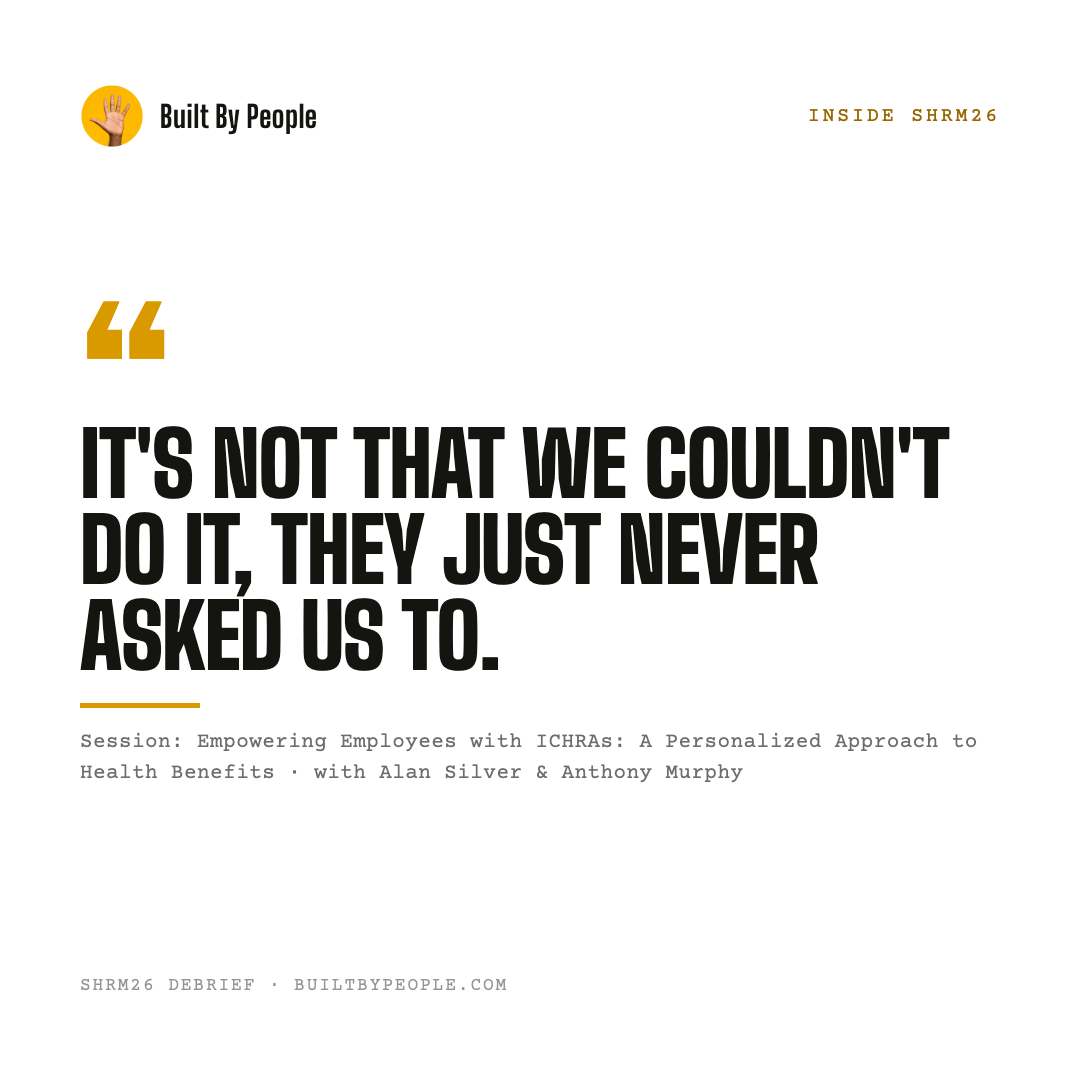
"It's not that we couldn't do it, they just never asked us to."
What it was about
ICHRA (Individual Coverage Health Reimbursement Arrangement) offers a viable, increasingly mature alternative to traditional group health insurance: employers set a defined contribution, and employees personalize their own coverage in the individual market. Paired with strong education and administration, that can lower and stabilize costs, increase choice, and improve satisfaction.
By the numbers
Key notes
- Interview third-party administrators and brokers/consultants specifically about their ICHRA implementation experience before switching — treating ICHRA like group insurance administration sets employers up to fail.
- Set contribution schedules that follow the individual market's age-based rate curve (a percentage of a benchmark plan) rather than flat dollar amounts, which over-subsidize younger employees and under-subsidize older ones.
- Budget for two months of premium due at the start of an ICHRA transition instead of the usual one month, since finance needs to plan for this cash timing shift.
Take this back Monday
Pull your health plan opt-out rate; if it's 30%+, ask your broker about ICHRA feasibility and age-based contribution modeling.
Group insurance isn't more equitable than ICHRA, it just hides the cross-subsidization by age and geography instead of managing it deliberately.
Watch out for
- Assuming employees will pick the 'wrong' plan by employer standards — individual buying behavior in the ICHRA market does not mirror employer assumptions (e.g., PPOs are bought by less than 15% of Ambetter's ICHRA population despite being offered).
- Giving every employee the same flat-dollar contribution regardless of age, which creates inequitable subsidization skewed toward younger employees.
- Treating ICHRA administration and broker relationships the same as group insurance — using an administrator or advisor without dedicated ICHRA implementation experience lowers the odds of success.
Before benefits strategy, Hunter Foster was a registered nurse who helped lead his city's largest COVID unit at the height of the pandemic.