Creating Resilient Leaders who Thrive in Turbulent Times

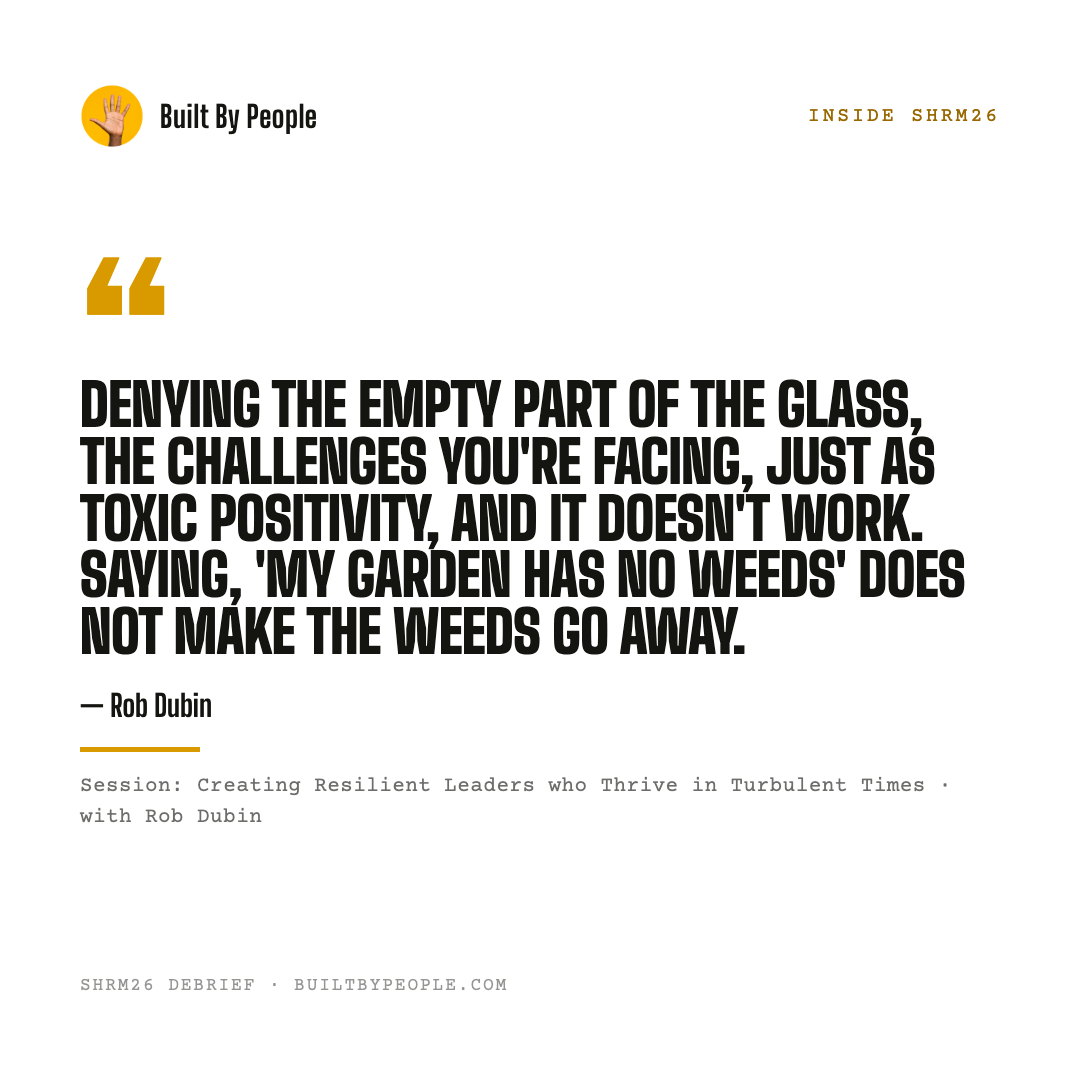
"Denying the empty part of the glass, the challenges you're facing, just as toxic positivity, and it doesn't work. Saying, 'My garden has no weeds' does not make the weeds go away."
What it was about
Optimism, resilience, purpose, and decisive action are learnable, trainable traits (drawn from surviving a five-day Colorado blizzard and decades of filming high achievers) that let leaders treat constant change, including AI, as an opportunity rather than a threat.
By the numbers
Key notes
- Cultivate optimism by first acknowledging the empty part of the glass (real challenges), then the full part (your strengths and resources). Then deliberately spend three times more time and energy generating solutions than dwelling on the problem.
- In meetings, enforce a rule that the group spends three times as long discussing solutions as it spends discussing the problem, which shortens meetings and increases the number of solutions generated.
- Build resilience through three practices: get back up again and again after setbacks, 'stack your wins' by mentally cataloguing past challenges you've overcome, and actively look for post-traumatic growth (becoming stronger, not just surviving) after hard experiences.
Take this back Monday
In your next team meeting, cap problem talk then spend 3x longer generating solutions before moving on.
Resilience isn't toxic positivity — it's naming the real problem, then spending three times more energy on solutions than on the problem itself.
Watch out for
- Denying or minimizing real challenges ('my garden has no weeds') as toxic positivity, which does not make problems go away.
- Spending disproportionately more time discussing problems than discussing solutions, leading to long, unproductive meetings.
- Defaulting to a Neanderthal/amygdala-driven fear response that treats change as dangerous rather than engaging the prefrontal cortex to see change as opportunity.
Rob Dubin and his wife spent 17 years sailing around the world, visiting more than 100 countries to study how people find calm amid uncertainty.