Beyond Inclusion Training: Building Cultures that Get Real
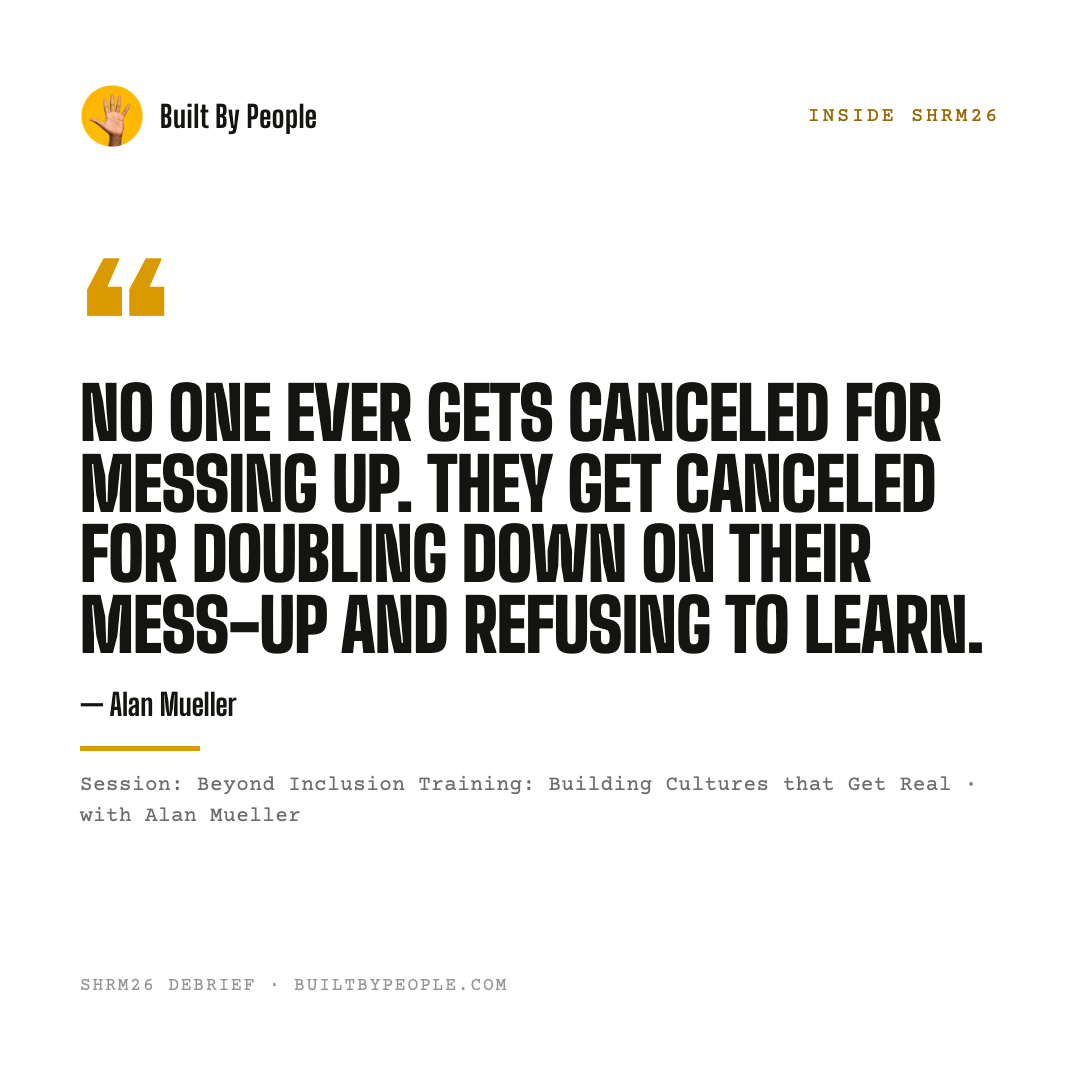
"No one ever gets canceled for messing up. They get canceled for doubling down on their mess-up and refusing to learn."
What it was about
Standard climate surveys and value statements only tell organizations what they already know about inclusion. Real, sustainable cultural change comes from moving groups from broad shared values to specific, negotiated shared expectations, paired with qualitative tools like focus groups and ongoing cultural humility and curiosity.
By the numbers
Key notes
- Run a shared-expectations exercise with teams (not just abstract value statements) and interrogate each word offered — ask what people can actually commit to, and modify or remove words the group can't honestly own.
- Replace one-size-fits-all quantitative climate surveys with qualitative methods like facilitator-led focus groups, and train internal staff (train-the-trainer) so the organization can run them without permanent reliance on outside consultants.
- Distinguish types of 'safety' (personal/physical vs. psychological) explicitly in team agreements rather than using the word as a vague, feel-good label.
Take this back Monday
Run a shared-expectations exercise with your team: list values, then cross out any word people can't actually commit to living.
Climate surveys just confirm what the majority already believes — real inclusion data comes from focus groups, not Likert scales.
Watch out for
- Relying solely on quantitative climate surveys, which mainly confirm what majority groups already believe and fail to surface minority experience.
- Adopting person-first or other identity language wholesale without checking what the community itself actually prefers (e.g., autistic people vs. people with autism).
- Treating diversity/inclusion work as a one-time training or a static value statement instead of a living, recurring practice.
Before leadership consulting, Dr. Mueller spent nearly a decade performing professional improv comedy with an award-winning troupe.