Automation, AI, and Job Displacement Risk in U.S. Employment

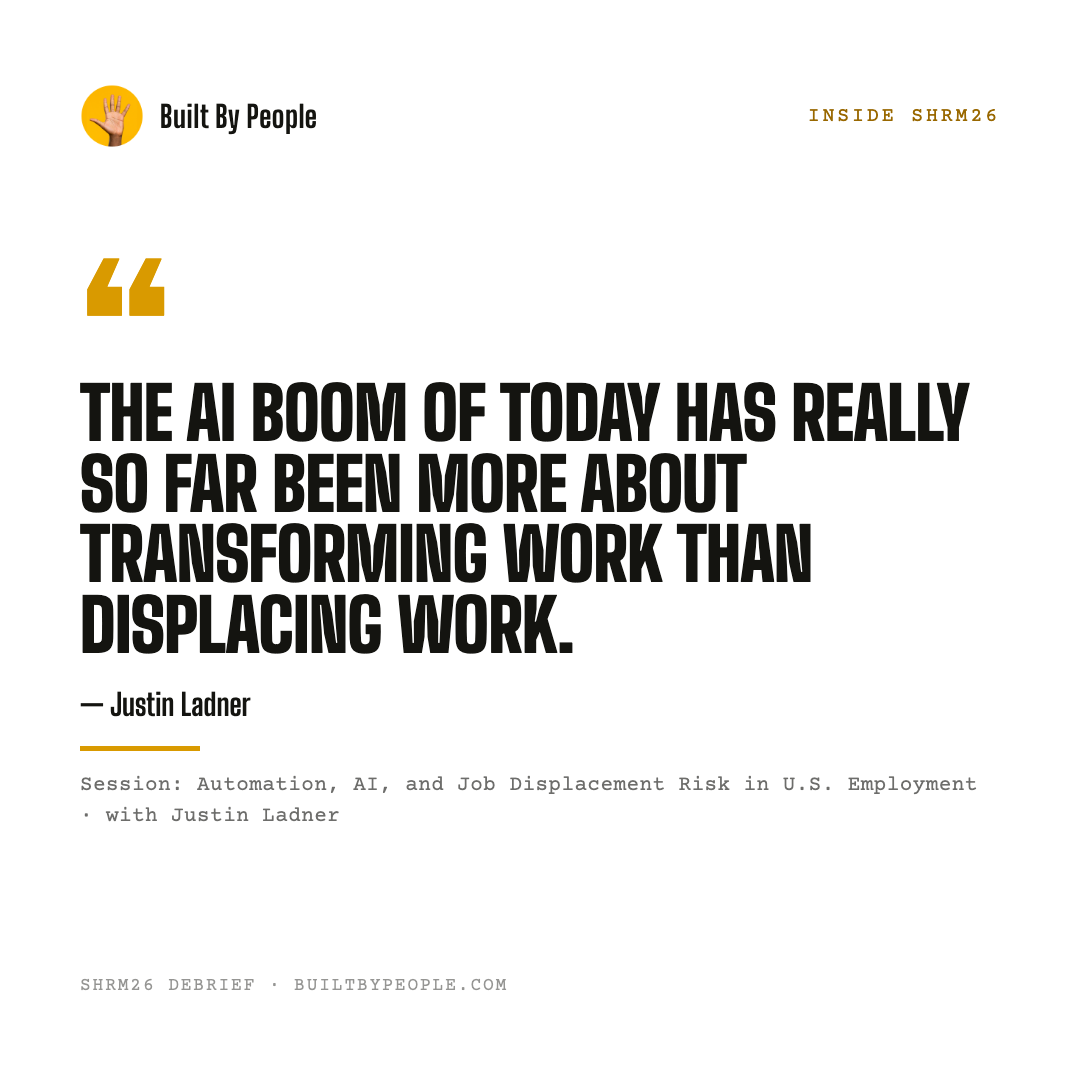
"The AI boom of today has really so far been more about transforming work than displacing work."
What it was about
Based on SHRM's 2026 survey of 14,245 U.S. workers, task automation and AI usage have surged across occupations. But non-technical barriers, like client preferences, legal and regulatory issues, cost-effectiveness, and organizational constraints, shield the large majority of jobs from displacement. Today's AI boom looks more like a gradual transformation of work than a mass-displacement event, though about 5.1% of U.S. employment (7.9 million jobs) currently faces high automation displacement risk.
By the numbers
Key notes
- Distinguish task automation from AI usage in your workforce planning: they are correlated but distinct concepts; 43.3% of workers report higher AI usage than task automation, meaning AI is often used for augmentation, not automation.
- Identify and document the non-technical barriers protecting roles in your organization (client preferences, legal/regulatory requirements, cost-effectiveness, organizational constraints) since 60.4% of U.S. jobs have at least one such barrier.
- Prioritize retention and reskilling conversations for entry-level white-collar roles, since these are disproportionately automatable and recent college graduates are already struggling in the labor market as a result.
Take this back Monday
List which roles on your team have a non-technical protection (client trust, compliance, cost) and flag entry-level roles that lack one for reskilling talks.
AI is transforming work more than displacing it — only 5.1% of U.S. jobs face high automation risk, so our plan is reskilling, not mass layoffs.
Watch out for
- Treating an entire occupation as uniformly 'exposed' or 'not exposed' to AI/automation risk instead of recognizing that risk is probabilistic and varies job-by-job based on firm-level factors like company size and capital availability.
- Assuming AI usage automatically implies task automation (or vice versa): the data shows these are correlated but meaningfully distinct in how workers use them.
- Wholesale replacing customer-facing teams with automation without accounting for client preference for human interaction, as Klarna did before rehiring staff.