2026 State of AI in the Workplace

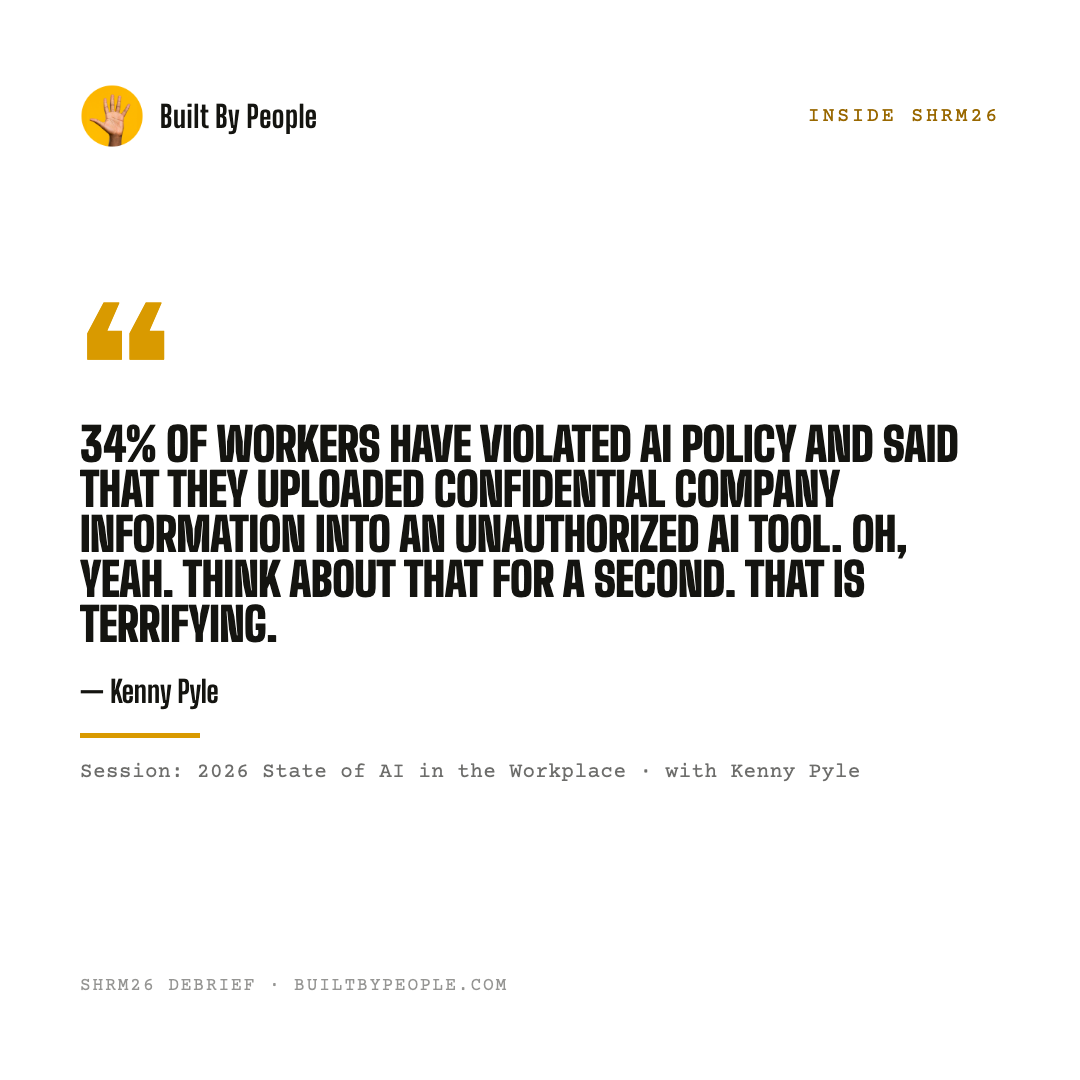
"34% of workers have violated AI policy and said that they uploaded confidential company information into an unauthorized AI tool. Oh, yeah. Think about that for a second. That is terrifying."
What it was about
AI adoption at work is real but far messier and less uniform than headlines suggest. Usage, policy compliance, aptitude, and impact vary sharply by job level, and organizational culture matters as much as the technology itself in determining whether AI integration succeeds.
By the numbers
Key notes
- Develop and actively communicate a clear, accessible AI use policy, since only 47% of organizations have one and 30% of workers admit to violating whatever policy exists.
- Build targeted, ongoing AI training programs at every job level rather than one-off sessions, since self-reported AI experience does not match actual aptitude test performance.
- Reinvest the time AI saves (workers report saving about six hours per week) into complex problem-solving, creative work, and skill development rather than assuming it disappears into extra output.
Take this back Monday
Publish a plain-language AI use policy and walk through it with your team, since 30% admit violating unwritten or unclear rules.
Our biggest AI risk isn't job loss, it's the 34% of employees pasting confidential data into unauthorized tools because we never published a policy.
Watch out for
- Assuming leadership's self-reported AI expertise is accurate: directors and above overestimated their skill while actually producing the most AI slop.
- Relying on negative consequences or informal, one-off training sessions to drive adoption, which the data shows are the least effective tactics.
- Failing to communicate AI policy evenly across levels: only one in three individual contributors were informed about AI implementation beforehand, versus 74% of directors.
Before HR tech analysis, Kenny Pyle's career spanned founding a startup, a Fortune 500 company, academia, and the entertainment industry.